I've always loved books about the making of movies, particularly the ones that go beyond the usual promotional interviews and behind-the-scenes photographs to tell me something I didn't already know.
That's a pretty difficult thing to accomplish when you're writing about Quentin Tarantino. He's one of the most extensively interviewed directors working today, and if you're a fan of his movies, there's a good chance you've already spent countless hours listening to him explain how they came together.
Tarantino is my favorite director, so I figured I knew quite a bit about Once Upon a Time in Hollywood (2019). Then I read Jay Glennie's The Making of Quentin Tarantino's Once Upon a Time in Hollywood. It's an enormous book filled with previously untold stories, production documents, interviews and incredible artwork, all assembled into one of the most impressive accounts of the filmmaking process I've encountered. And fair warning: after reading it, you're probably going to want to watch the movie again.
Here are five reasons I think this book belongs on the shelf of anyone who loves Tarantino or simply wants to learn more about how movies get made.
Watch the Force Five Video
5 Reasons to Read The Making of Quentin Tarantino's Once Upon a Time in Hollywood
#5: Jay Glennie Is One of the Best Making-Of Authors Working Today
In my opinion, Jay Glennie is the gold standard when it comes to writing books about the making of movies. He's previously written extensively researched books about The Deer Hunter and Raging Bull, two films with incredibly complicated production histories and more than enough fascinating stories to fill several books. What separates Glennie's work from a typical movie tie-in is his determination to track down the people who actually participated in making the film, and in the case of Once Upon a Time in Hollywood, he had access to somebody pretty important.
Quentin Tarantino himself.
The story of how their collaboration began is wonderful. Glennie was preparing a book about Taxi Driver and approached Tarantino because he knew the director was an enormous fan of Martin Scorsese's film. He thought their initial conversation might last about ten minutes, which seems remarkably optimistic if you've ever heard Tarantino talk about movies. Instead, they ended up opening some wine, talking about filmmaking and developing the idea for a whole series of books covering Tarantino's filmography. And that brings us to the enormous number nine embossed on the spine.
Once Upon a Time in Hollywood is Tarantino's ninth film, and the goal is to eventually build a ten-volume collection exploring his work in extraordinary detail.
I should probably start looking for another bookshelf.
#4: The Access to the Cast and Crew Is Extraordinary
This book features interviews with more than 65 people who worked on Once Upon a Time in Hollywood, and when I say people, I mean just about everybody. Leonardo DiCaprio, Brad Pitt and Margot Robbie are here, along with Kurt Russell, Dakota Fanning, Margaret Qualley, Austin Butler, Mikey Madison and many more. Tarantino contributes extensively, discussing everything from his early ideas to the challenges of translating them into the finished movie, but what impressed me most is that Glennie doesn't simply concentrate on the actors whose names appear at the top of the poster. He also spends an enormous amount of time talking to the artists and technicians responsible for turning 2010s Los Angeles into the Los Angeles of 1969.
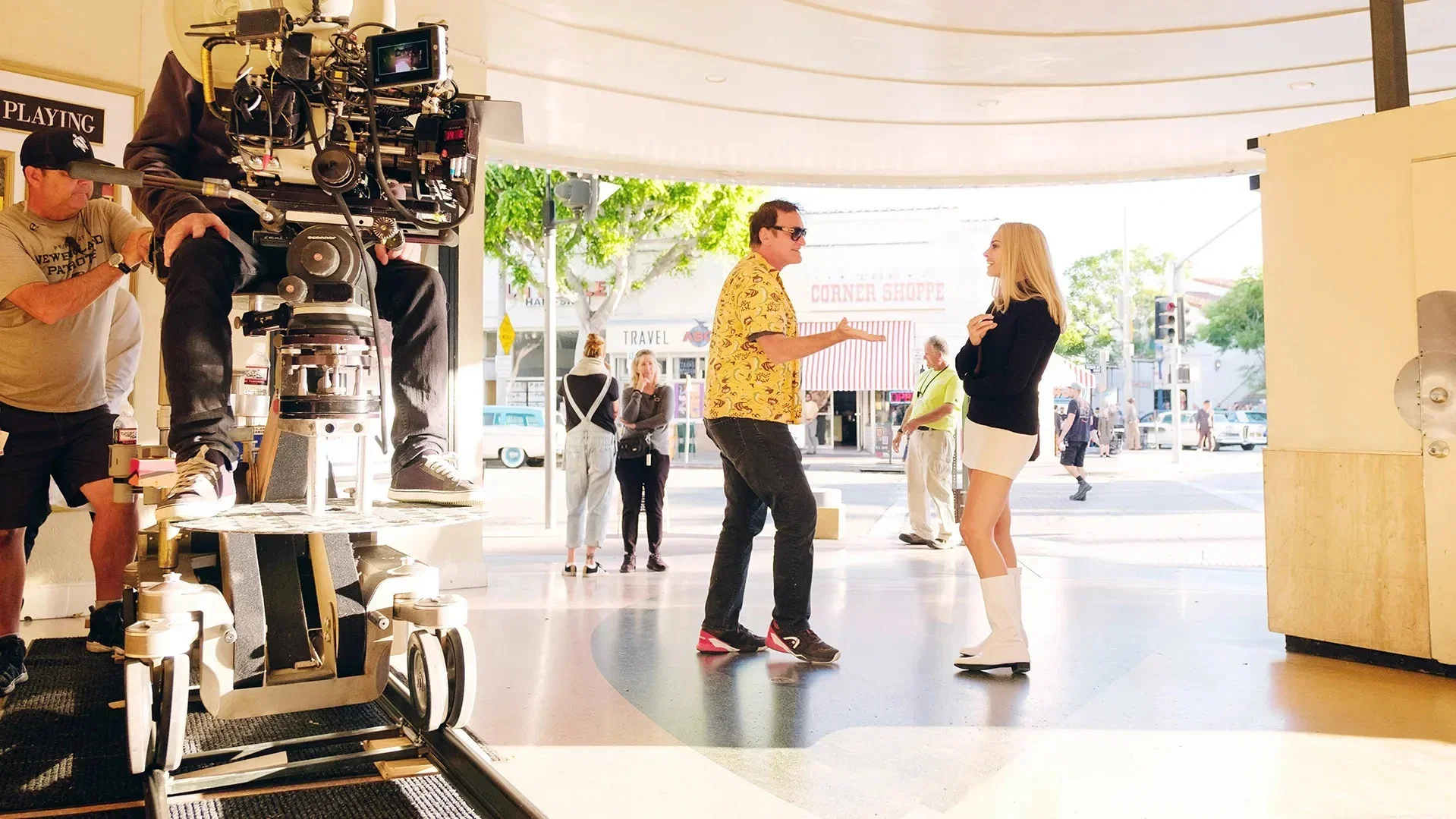
You've got cinematographer Robert Richardson, production designer Barbara Ling, costume designer Arianne Phillips and numerous other people whose work is essential to making the film convincing. There's a tendency to discuss movies as though a director simply imagines something and it magically appears on screen. Obviously, that's not how filmmaking works. Somebody has to figure out how to recreate an entire neighborhood, build a convincing television set from the 1960s, design costumes that reflect specific personalities and create props that might only appear for a couple of seconds. Glennie gives those people an opportunity to explain what they contributed, and Tarantino reportedly encouraged him to tell the story honestly, including the difficult or uncomfortable parts of the production.
That's exactly what I want from an authorized making-of book.
#3: This Thing Is Absolutely Enormous
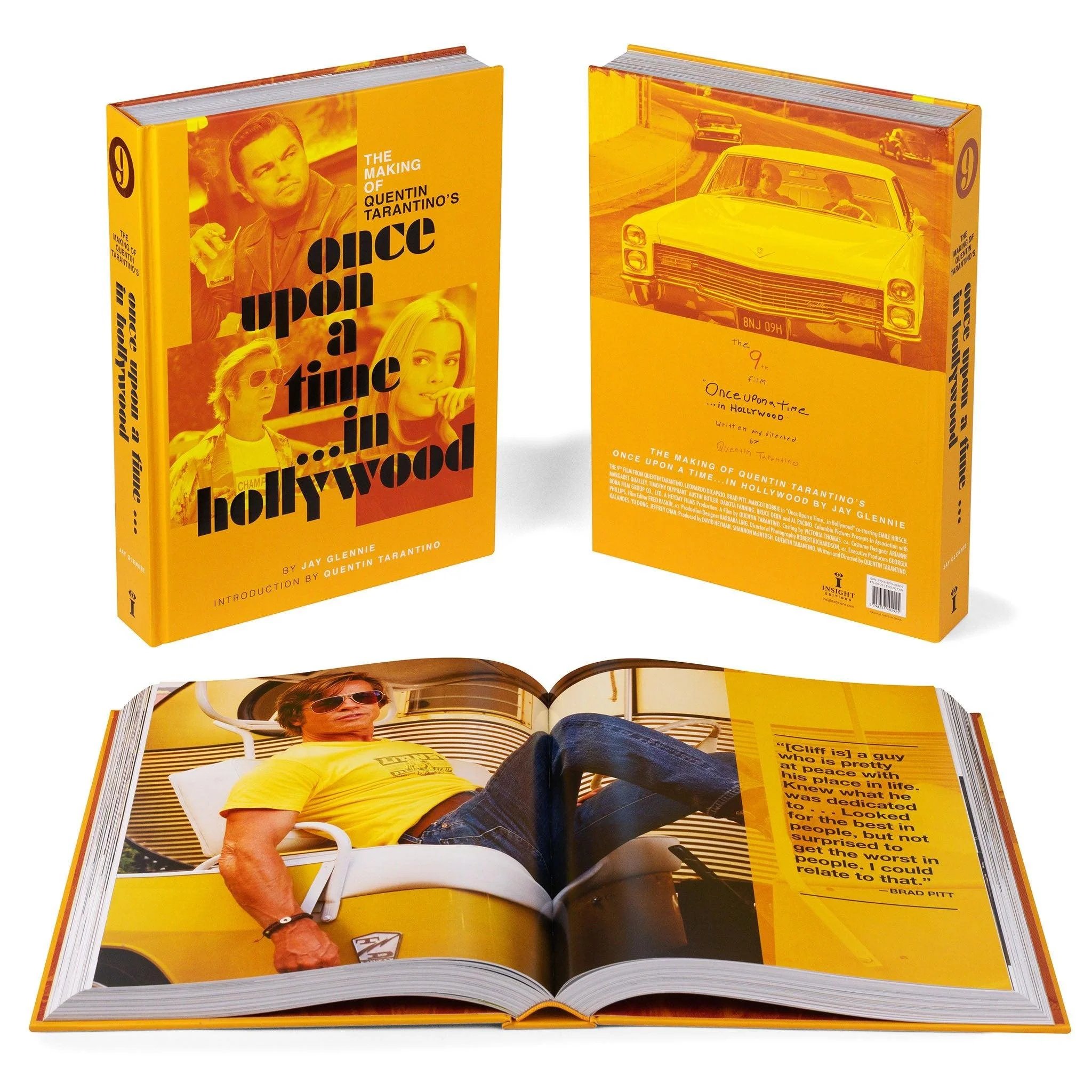
I should probably mention that this is not a book you're going to casually toss into your backpack.
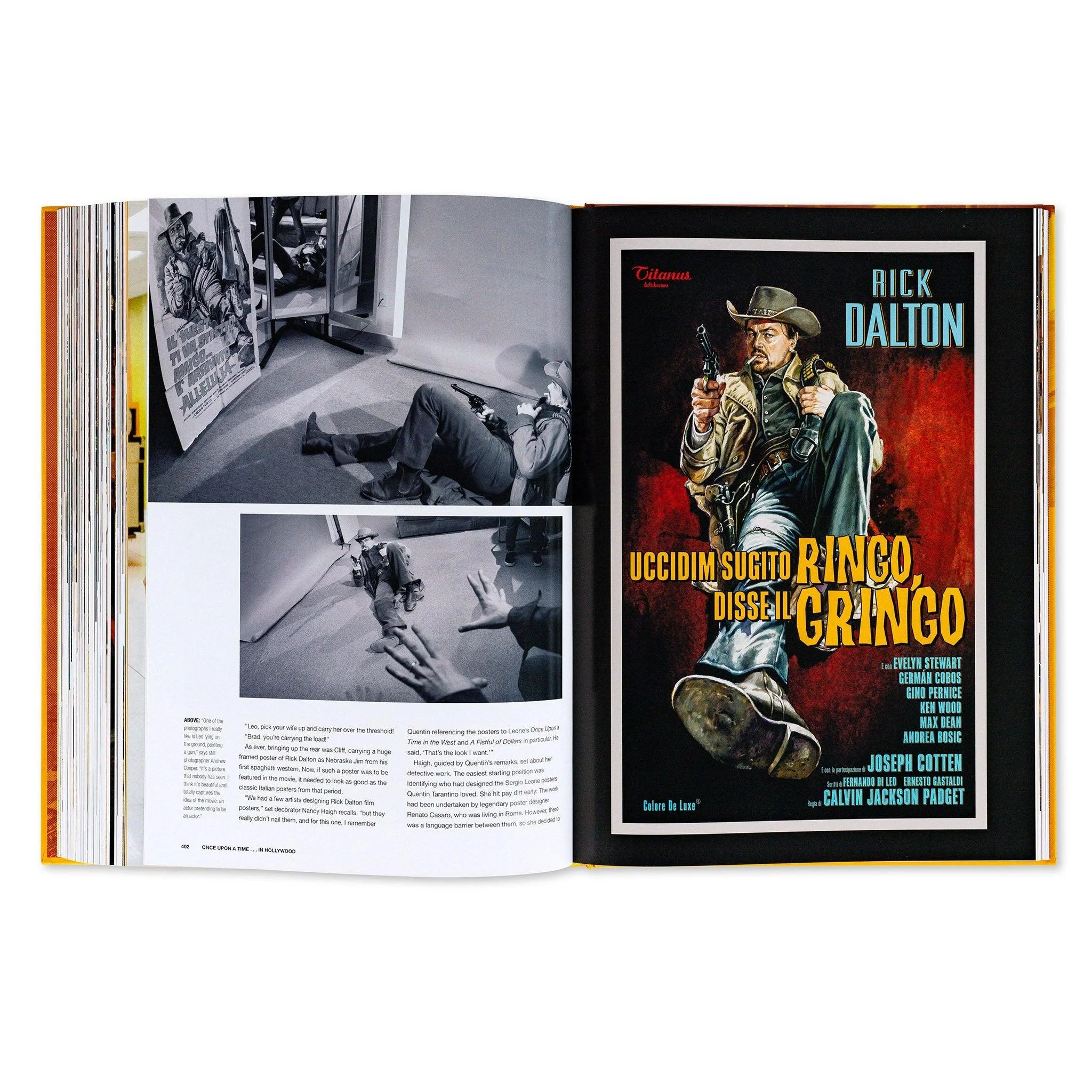
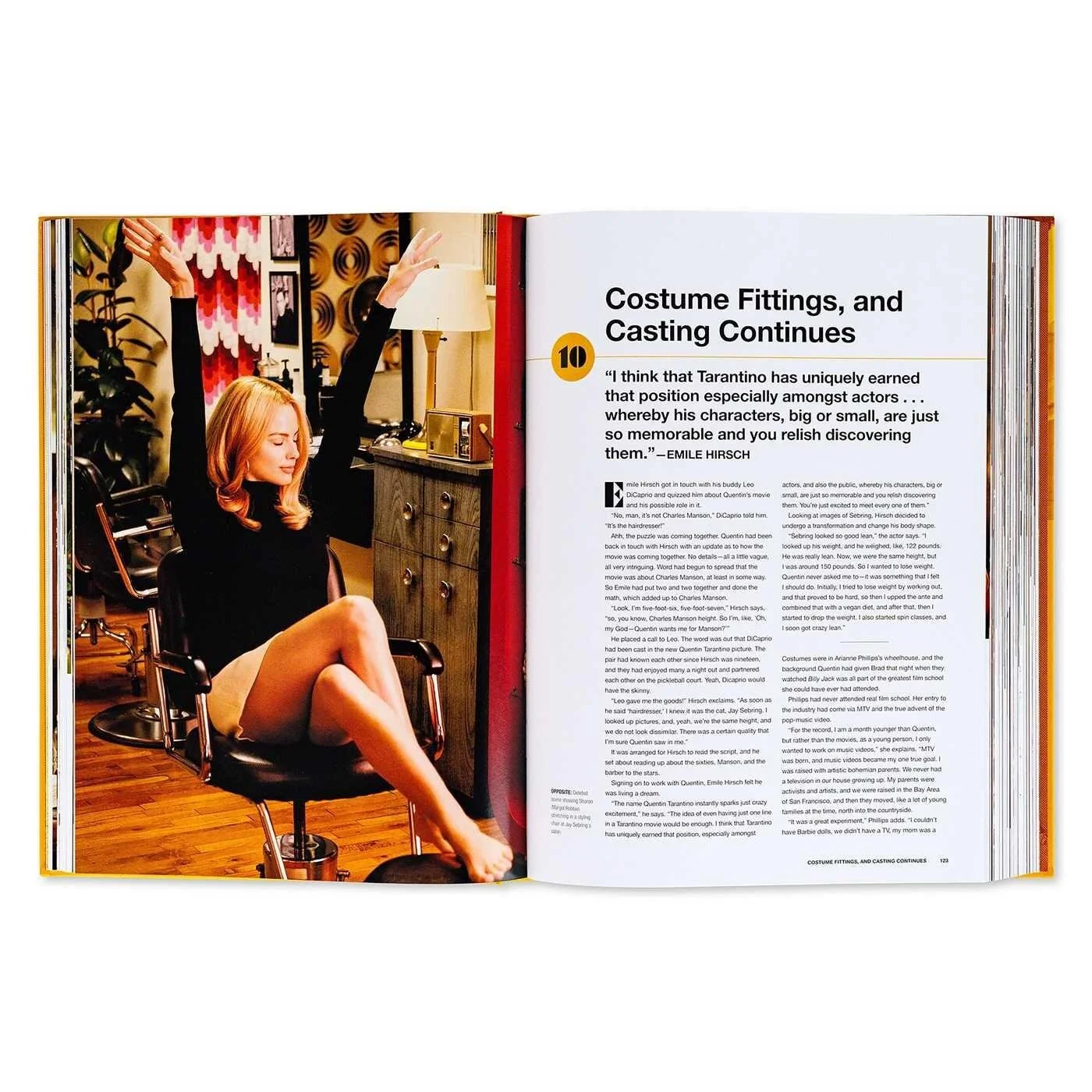
It's 488 pages long, contains approximately 170,000 words and weighs enough that you're going to want a reasonably substantial coffee table. Seriously, look at this thing. Marvel at its girth…but it's not simply a massive collection of interviews with a few promotional photos thrown in to break up the text. It's filled with behind-the-scenes photographs, handwritten notes, screenplay pages, production documents, concept art, costume sketches and artwork created specifically for the film.
One of my favorite aspects of Once Upon a Time in Hollywood is how much work went into creating the fictional films and television programs that exist inside its world. Rick Dalton has an entire career that the audience only gets to glimpse through small pieces of television footage, posters and promotional material, and somebody had to create all of that. Thanks to this book, you can appreciate much of that work in considerably greater detail.
There's also an incredible amount of material devoted to the costumes and the process of recreating 1969 Hollywood, right down to details that most viewers probably never noticed during the movie, and I love that.
It's a reminder that movies are physical things created by real people, and even a prop that appears in the background for three seconds can represent hours of someone's work.
#2: The Behind-the-Scenes Stories Are Worth the Price of Admission
Obviously, I'm not going to spoil all the fascinating stories Glennie uncovered, because I want people to read the book, but I can give you a few examples of the kinds of things you'll discover.
Did you know Margot Robbie selects a perfume for each character she plays, using the scent to help establish a connection to that person? For her portrayal of Sharon Tate, that ritual became particularly meaningful. There's also a story about an extremely famous director visiting the Bounty Law set and being told to hand over his phone before entering. Another famous director's daughter apparently found herself being asked whether she'd be comfortable dumpster diving.
I don't know about you, but those are exactly the kinds of stories that make me want to pick up a filmmaking book. You'll learn about the recreation of Spahn Ranch, how various actors approached their roles, the decisions behind individual scenes and material that didn't make it into the finished movie. There's also a particularly touching story involving Luke Perry, who played Wayne Maunder in the film.
One thing I appreciate is that Glennie doesn't treat the biggest stars as the only people capable of telling an interesting story. Sometimes the most revealing anecdotes come from the people whose names you're unlikely to recognize unless you spend a lot of time reading movie credits, and there are so many stories here that I suspect I'll discover things I missed when I eventually read the book again.
#1: It Makes You Appreciate the Movie Even More
The biggest reason I'd recommend this book isn't the number of interviews or the enormous collection of photographs. It's the way Glennie organizes everything. Rather than simply listing a series of facts or describing what happened during each week of production, he tells the story in a way that follows the experience of creating the movie.
You learn how individual scenes were conceived, how actors developed their characters, how the sets and costumes came together and how the footage was shaped into the finished film. The interviews aren't simply presented as a collection of unrelated conversations. They become part of a larger story about hundreds of people working toward the same creative goal, and I think that's what makes the book special.
Once Upon a Time in Hollywood is already a movie fascinated by the filmmaking process.
Rick Dalton is an actor struggling to remain relevant in an industry that's changing around him. Cliff Booth is a stuntman whose entire career depends on the person standing in front of the camera. And Sharon Tate represents a different kind of possibility in a Hollywood filled with people whose futures are still unwritten.
There's something appropriate about a making-of book that gives the real artists behind those fictional characters the same attention Tarantino gives the people in his movie. I finished the book with a much greater appreciation for the finished film, but also for the extraordinary amount of work that went into creating it, and even though I've seen Once Upon a Time in Hollywood several times already, I immediately wanted to watch it again.
That's probably the highest compliment I can give a book about the making of a movie.
Who Should Read This Book?
If Quentin Tarantino is one of your favorite filmmakers, I think this book is essential.
But I also think it's worth picking up if you simply enjoyed Once Upon a Time in Hollywood and want to learn more about the extraordinary work that went into recreating Los Angeles in 1969.
It's especially valuable for aspiring filmmakers, screenwriters, production designers, cinematographers and anybody who's curious about how a movie moves from an idea in somebody's head to something audiences can experience.
It isn't a quick read or an inexpensive little paperback. It's a substantial reference book that rewards the time you spend with it.
But I can't imagine somebody who genuinely loves studying the filmmaking process being disappointed by the amount of material Glennie has assembled.
Where to Buy The Making of Quentin Tarantino's Once Upon a Time in Hollywood
Published by Insight Editions in October 2025, Jay Glennie's The Making of Quentin Tarantino's Once Upon a Time in Hollywood is available as a 488-page hardcover.
The oversized physical edition is the version I'd recommend because the book's design, large photographs, artwork and reproduced production materials are such a major part of the experience.
View the book and other purchase options at Simon & Schuster
ISBN: 9798337402925
The Quentin Tarantino Library Continues
The good news is that this isn't a one-off project.
Glennie and Tarantino are planning a series of ten substantial making-of books exploring the director's filmography.
The second volume, The Making of Quentin Tarantino's Inglourious Basterds, was released in November 2026, and Django Unchained is planned as the third installment.
If the remaining volumes are anything like this first one, I'm going to have to figure out where to put them.
Prefer to Listen?
If you'd rather listen to my recommendation, the Force Five audio episode covers five reasons I think Jay Glennie's book is worth owning, from its extraordinary interviews and rare artwork to the way it reveals the work of the hundreds of people who brought Tarantino's movie to life.
More Film Books Worth Exploring
If you enjoy Glennie's work, his earlier books about The Deer Hunter and Raging Bull are natural next stops. Both films have complicated production histories, and Glennie's research offers the same kind of detailed look at the people responsible for creating them.
I'd also recommend looking at the wider tradition of comprehensive making-of books, including J.W. Rinzler's work on the Star Wars films and The Making of Alien. These are books that demonstrate how fascinating the process of making a movie can be, sometimes even when you already know practically everything that happens on screen.
And if you haven't read Quentin Tarantino's novelization of Once Upon a Time in Hollywood, that's another interesting companion. It offers a different perspective on Rick Dalton, Cliff Booth and the world Tarantino created for the film.
More Force Five
If you enjoy Quentin Tarantino's characters as much as I do, check out Force Five Live: The Quentin Tarantino Character Draft. I joined Scott from The Church of Tarantino and Pete Abeyta from The Middle Class Film Class for a discussion of the filmmaker's most memorable characters. It's an entertaining way to revisit Tarantino's filmography and a natural companion to Glennie's work.
Glennie's earlier books about The Deer Hunter and Raging Bull also make Jacknife (1989) a worthwhile recommendation. Robert De Niro stars alongside Ed Harris and Kathy Baker in a comparatively overlooked drama about the lasting effects of the Vietnam War. It isn't a Tarantino movie, but if you enjoy exploring the work of great actors beyond their most famous performances, there's plenty to appreciate here.
And speaking of recognizable actors turning up in overlooked movies, Walking the Edge (1985) features Robert Forster, who Tarantino fans will recognize from Jackie Brown. It's another reminder of how much enjoyment there is in exploring an actor's larger filmography rather than concentrating exclusively on the most celebrated titles.
Final Thoughts
I don't think I've ever finished a making-of book with quite this much new information about a movie I already loved.
Jay Glennie has put together something special, and I genuinely hope the remaining Tarantino Library volumes maintain this standard.
Have you read the book? What's your favorite making-of movie book? And if you could have this same treatment for absolutely any film, which one would you choose?
Life is short. Spend it with the people, and the movies…and the books, that you love.
