
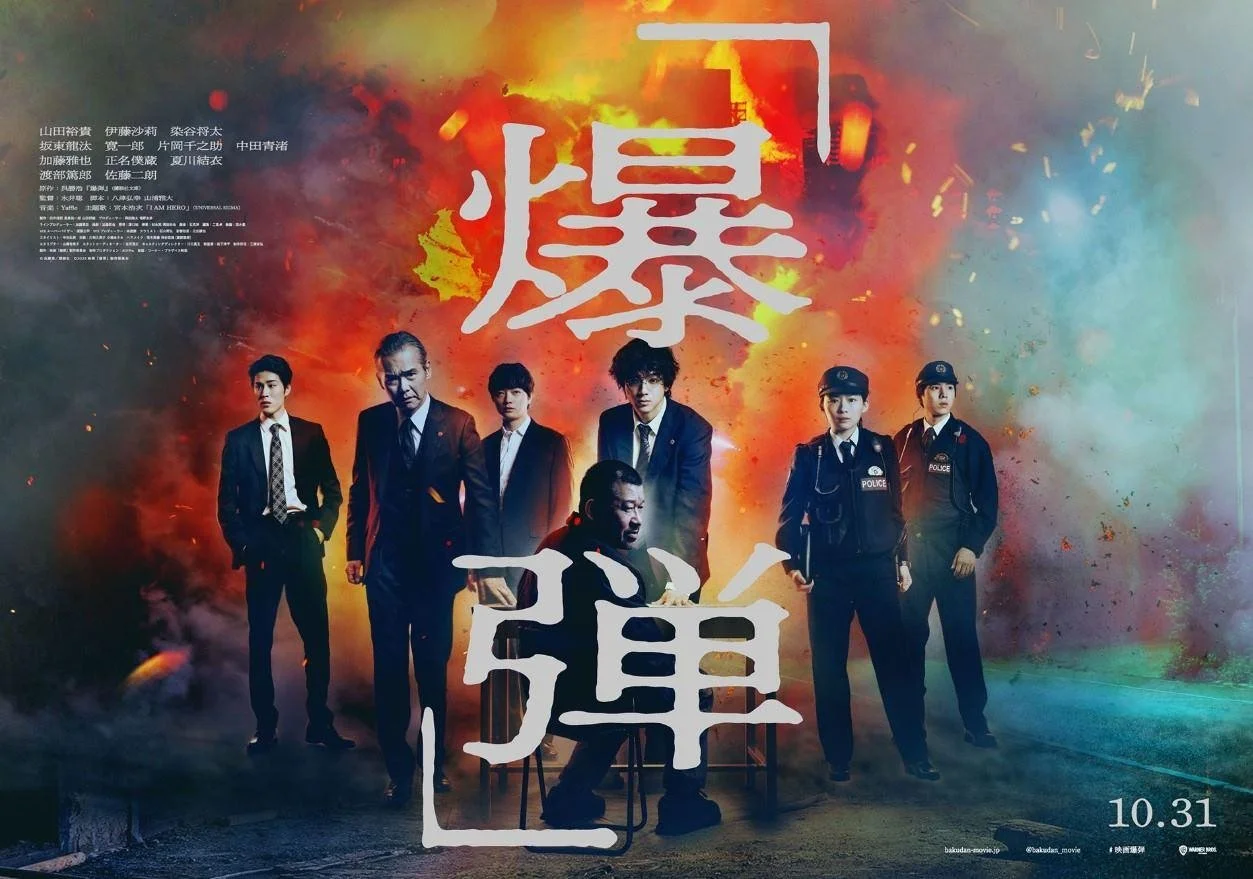
I love a good crime thriller where the police have somebody sitting in an interrogation room who clearly knows more than he's letting on.
You know the type. The suspect seems perfectly comfortable, the detectives are getting increasingly frustrated and every answer leads to three more questions. Eventually, you're wondering whether the person being interrogated is actually the one controlling the entire investigation.
Akira Nagai's SUZUKI=BAKUDAN (2025) takes that idea and runs with it.
Based on Katsuhiro Go's bestselling novel Bomb, the movie begins when a seemingly ordinary drunk named Tagosaku Suzuki is arrested after vandalizing a vending machine. During questioning, Suzuki casually predicts an explosion in Tokyo.
Then it happens.
He claims there are more bombs waiting to detonate, but instead of telling the police where they are, he starts presenting them with riddles.
What follows is a tense Japanese crime thriller that combines an elaborate mystery, a citywide police investigation and one of the most entertaining movie villains I've seen recently.
Here are five reasons you might want to watch SUZUKI=BAKUDAN.
Watch the SUZUKI=BAKUDAN Video
5 Reasons to Watch SUZUKI=BAKUDAN
#5: If You Like Se7en or The Usual Suspects, You'll Love the Setup
There's something inherently fascinating about a criminal who appears to be several steps ahead of everybody trying to catch him.
Se7en gave us John Doe, a killer whose elaborate crimes gradually reveal an entire philosophy. The Usual Suspects gave us a mysterious criminal history that becomes increasingly difficult to separate from the person telling the story.
SUZUKI=BAKUDAN has a little of both.
Suzuki doesn't look like somebody who should be capable of orchestrating a citywide terrorist attack. He's a disheveled, seemingly harmless middle-aged man who's been arrested for doing something incredibly stupid.
Then he starts predicting explosions.
And suddenly, every word out of his mouth becomes important.
The police have to figure out whether Suzuki is actually responsible for the bombs, whether he's working with somebody else or whether there's another explanation for his apparent knowledge of the future.
Meanwhile, there are actual people scattered around Tokyo who could die while the detectives try to solve his puzzles.
That creates two very different kinds of suspense. Inside the interrogation room, you've got a battle of wits between Suzuki and the investigators. Outside, police officers are racing around the city trying to prevent another explosion.
The movie moves between these two situations in a way that constantly raises the stakes. Even when Suzuki is sitting perfectly still, he's probably the most dangerous person in the film.
If you enjoy movies about criminals who turn an investigation into an elaborate game, this is absolutely worth checking out.
#4: Akira Nagai's Direction Keeps Everything Moving
One of the challenges of making a movie like SUZUKI=BAKUDAN is that so much of the story revolves around people talking.
There's only so much visual excitement you can get out of an interrogation room unless the filmmaker knows how to make the conversation itself feel dangerous.
Thankfully, Akira Nagai understands that.
Nagai previously directed Teiichi: Battle of Supreme High and Character, and here he takes what could have been a fairly static police procedural and turns it into something considerably more energetic.
The movie moves between the interrogation room, the police investigation and the increasingly desperate search for bombs around Tokyo.
That structure gives Nagai plenty of opportunities to vary the pacing.
One minute, we're watching Suzuki say something that completely changes the direction of the questioning. The next, we're following officers through crowded city streets as they attempt to act on information that might not even be accurate.
What I particularly appreciate is that Nagai doesn't seem afraid to let a scene play out when the actors are doing something interesting.
There are moments when the camera simply observes the conversation, allowing Suzuki's strange behavior and the detectives' reactions to create the tension.
And when the movie shifts into the larger investigation, the energy changes considerably.
The result is a film that manages to feel urgent without constantly beating you over the head with action.
It also looks terrific, with the stark interrogation-room lighting contrasting against the enormous city that Suzuki seems to have turned into his personal playground.
If you enjoy confident, carefully controlled crime-thriller filmmaking, Nagai gives you plenty to appreciate.
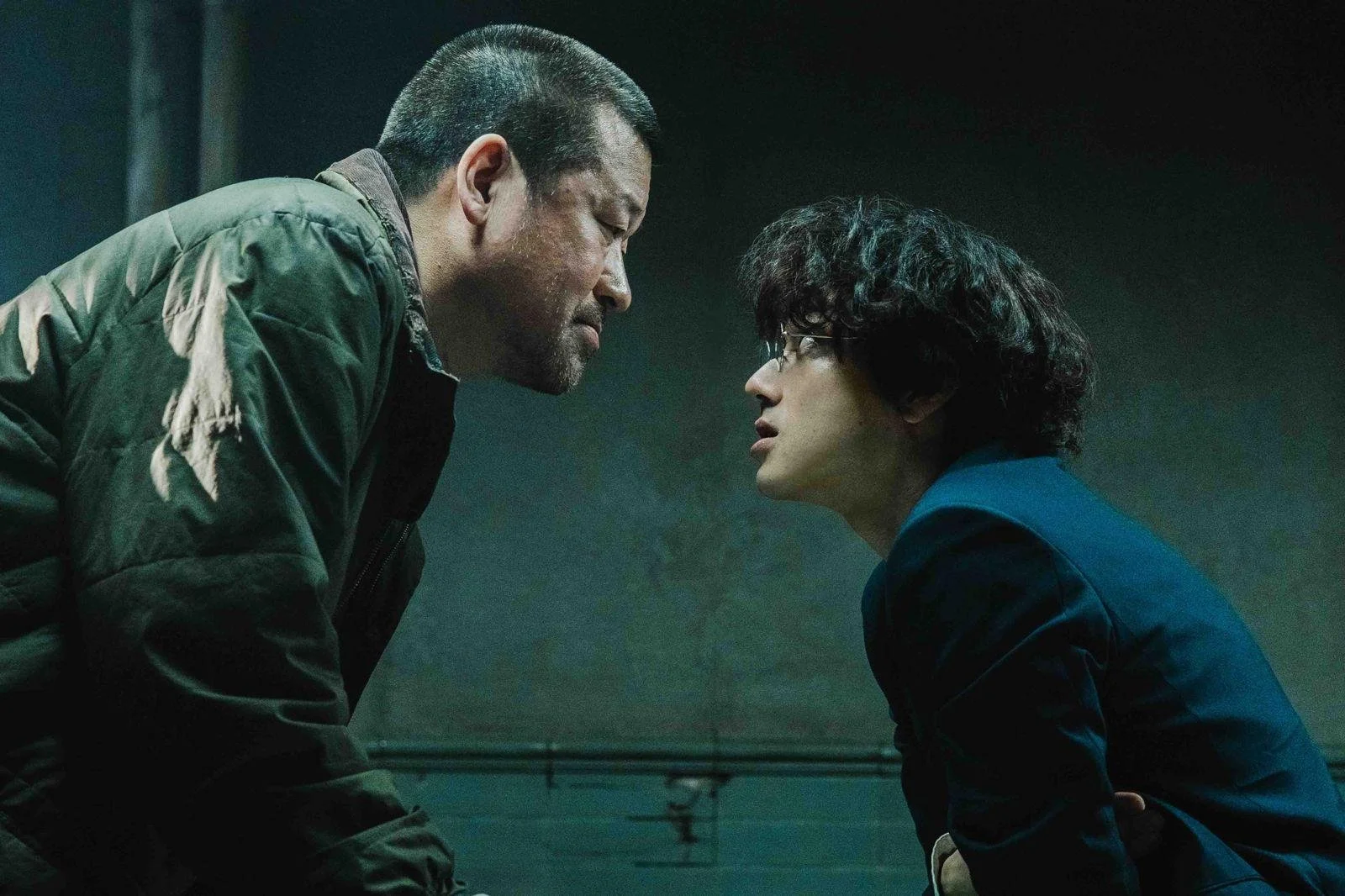
#3: The Mystery Is a Fantastic Puzzle Box
I love movies that make me feel like I'm participating in the investigation.
Knives Out does this with an elaborate collection of suspects and constantly changing interpretations of what happened. Memento forces us to reconsider information because of the way the story is presented. Primal Fear turns an apparently straightforward criminal case into something considerably more complicated.
SUZUKI=BAKUDAN belongs in that tradition.
Suzuki isn't simply refusing to cooperate with the police. He's giving them information in a form that requires them to think differently.
Every riddle becomes another opportunity to make a mistake, and the consequences of getting something wrong are considerably more serious than losing a game of trivia.
I appreciate that the movie doesn't treat the detectives like idiots just to make Suzuki appear intelligent.
These are capable investigators who recognize that they're dealing with somebody unusual. The problem is that Suzuki seems to understand how they think, and he keeps using their assumptions against them.
There's also the question of what Suzuki actually wants.
Does he want to escape? Does he want recognition? Is he enjoying the attention? Or does everything he's doing serve a purpose that the detectives haven't figured out yet?
The film provides enough information to encourage you to develop theories without immediately telling you whether you're right.
And because the investigation unfolds against a deadline, there's never unlimited time to sit around discussing the possibilities.
That's an excellent foundation for a mystery thriller.
I wouldn't spoil the various revelations because trying to understand Suzuki is a huge part of the enjoyment. Just know that this is the kind of movie where seemingly insignificant details can become considerably more important later.
#2: There's a Pretty Nasty Social Critique Underneath the Mystery
One of the things that makes SUZUKI=BAKUDAN more interesting than a standard police thriller is that Suzuki doesn't simply seem interested in outsmarting the detectives.
He also appears to enjoy exposing the uglier parts of the people around him.
The more the investigators engage with him, the more the conversation begins drifting toward questions of resentment, social status, prejudice and the way people decide whose lives are worth caring about.
Suzuki initially seems like the kind of person society would barely notice. He's unemployed, disheveled and apparently incapable of getting through an ordinary day without causing trouble.
But once he demonstrates that he might have information capable of saving lives, everybody suddenly has to pay attention to him.
And he absolutely loves that.
There's something disturbing about the idea that a person who would normally be dismissed or ignored can become powerful simply by discovering how to exploit the institutions and people who previously considered him insignificant.
The movie also keeps asking uncomfortable questions about the people attempting to stop him.
How much do they actually care about the victims? How much of their behavior is motivated by professional pride? And when they become emotionally invested in defeating Suzuki, are they still making the best decisions?
I don't think the film provides particularly comforting answers.
There's a real nastiness underneath the entertaining riddles and police-procedural mechanics, and I appreciate that Nagai and the screenwriters are willing to let some of those uncomfortable ideas remain unresolved.
If you like crime thrillers that have something unpleasant to say about society, SUZUKI=BAKUDAN has considerably more going on than its basic premise might suggest.
#1: Jiro Sato's Performance Is Absolutely Incredible
For all the things I enjoyed about SUZUKI=BAKUDAN, the biggest reason I'd recommend it is Jiro Sato.
Sato plays Tagosaku Suzuki, and it's one of those performances where you're constantly trying to figure out whether the character is an idiot, a genius, a psychopath or some combination of all three.
And that's what makes him so entertaining.
Suzuki can appear confused and harmless one moment, then say something that makes it painfully clear he's been paying attention to absolutely everything happening around him.
He'll mumble, laugh, ramble about something seemingly irrelevant or respond to a serious question with an expression that suggests he can't understand why everybody is making such a big deal out of the situation.
Then his demeanor changes.
Sometimes it's just a look. Sometimes it's the way he delivers a particular line. And sometimes it's the uncomfortable realization that Suzuki might have deliberately manipulated the entire conversation to get somebody exactly where he wants them.
It's a fascinating character because the movie never lets us feel completely comfortable interpreting his behavior.
Yuki Yamada is also excellent as detective Ruike, one of the investigators attempting to understand Suzuki. Their exchanges provide some of the film's best moments because the two performers seem to be engaging in their own little psychological battle.
You can practically feel the frustration building whenever Ruike believes he's finally making progress, only for Suzuki to introduce another complication.
Sato's performance has also received some well-deserved recognition. He won Best Supporting Actor at the 2026 Japan Academy Film Prize for playing Suzuki, and I can understand why.
This is the kind of villain who can dominate an entire movie without needing to participate in an elaborate chase or physically threaten anybody.
Most of the time, he just needs a chair, a table and somebody willing to listen to him talk.
And I couldn't stop watching.
Who Should Watch SUZUKI=BAKUDAN?
If you like Se7en, The Usual Suspects, Primal Fear, Memento, Knives Out or The Silence of the Lambs, SUZUKI=BAKUDAN should be on your radar.
It's an especially good recommendation for people who enjoy interrogation-room thrillers, police procedurals and mysteries where the central suspect seems to be manipulating everybody involved.
I'd also recommend it to fans of contemporary Japanese cinema who appreciate stories that combine clever genre mechanics with darker questions about society and human behavior.
The film runs a little over two hours, and it includes violent subject matter and disturbing implications. It requires some attention, particularly when Suzuki starts presenting his riddles.
But if you enjoy trying to figure out a mystery while the characters themselves are struggling to understand what's happening, I think you'll have a great time with this one.
Where to Watch SUZUKI=BAKUDAN
SUZUKI=BAKUDAN opened in Japanese theaters on October 31, 2025 and made its U.S. premiere at JAPAN CUTS in New York on July 18, 2026.
As of November 2026, I haven't been able to verify a U.S. subscription-streaming, digital-rental or digital-purchase option. The movie is available on Netflix in Japan, but that doesn't mean it's accessible to American subscribers.
Read about SUZUKI=BAKUDAN at Japan Society
Own SUZUKI=BAKUDAN on Blu-ray
The film received a Japanese Blu-ray release on May 1, 2026.
The Japanese edition is listed as region-free, but it doesn't currently list English subtitles, so English-speaking collectors should be aware of that before importing it.
View the Japanese Blu-ray at CDJapan
I'll update this section if a confirmed English-subtitled U.S. release or streaming option becomes available.
Prefer to Listen?
You can also hear this Force Five recommendation as a podcast episode exploring the same five reasons to watch SUZUKI=BAKUDAN, including the film's connections to classic crime thrillers, Akira Nagai's direction, the clever mystery and Jiro Sato's outstanding performance.
SUZUKI=BAKUDAN on the Force Five Top 5 Radar
Top 5 Interrogation-Room Thrillers
There's something wonderful about a movie that can make two people sitting across a table from one another feel as exciting as an elaborate action scene.
The Silence of the Lambs, The Usual Suspects, Primal Fear and SUZUKI=BAKUDAN would all deserve consideration for a list celebrating great interrogation scenes.
The interesting thing is that the person who appears to be in control isn't always the one asking the questions.
Suzuki understands that better than just about anybody.
Top 5 Movies Where One Criminal Holds an Entire City Hostage
Most movie villains settle for threatening a person, a family or maybe a building.
Some decide an entire city is a more appropriate target.
Die Hard with a Vengeance, The Dark Knight, Speed and SUZUKI=BAKUDAN all feature criminals who create situations where ordinary people become potential victims and the authorities have to play by rules they didn't establish.
What makes Suzuki particularly interesting is that he's already sitting in police custody. He doesn't need to escape to continue terrorizing Tokyo.
More Force Five
If the elaborate crime-thriller mystery is what grabbed you about SUZUKI=BAKUDAN, Force Five's review of The Whisper Man (2026) is a natural next stop. James Ashcroft's thriller feels like something pulled straight from the 1990s, complete with a mysterious killer, increasingly disturbing clues and investigators who have to work through the psychology of somebody capable of terrible things. Like Suzuki, the villain becomes fascinating partly because of what he chooses not to tell the people questioning him.
For another movie that enjoys repeatedly changing the audience's understanding of its mystery, Malice (1993) is worth revisiting. Harold Becker's twisty thriller stars Alec Baldwin, Nicole Kidman and Bill Pullman in a story that begins as one kind of movie before gradually becoming something considerably stranger. I had a lot of fun with its shifting motivations, red herrings and the realization that I probably shouldn't trust anybody involved.
If the darker social commentary was your favorite part of SUZUKI=BAKUDAN, Primetime (2026) is an interesting companion. Lance Oppenheim's unsettling film about the rise of To Catch a Predator explores the relationship between criminals, investigators and an audience that increasingly enjoys watching the entire spectacle unfold. It's a very different kind of thriller, but both movies raise uncomfortable questions about how much satisfaction people get from watching someone else lose control.
And for another recent Asian genre movie with an interest in corruption and the people who are failed by powerful institutions, Ghost in the Cell (2026) takes those concerns in a much more outrageous direction. Joko Anwar's Indonesian prison horror comedy features corrupt officials, grotesque supernatural violence and a social critique that's every bit as unpleasant as the monsters. It's far gorier and more ridiculous than SUZUKI=BAKUDAN, but both have more on their minds than simply entertaining you.
