How to Start a Podcast.
I’ve been up and running for close to three years now, so I thought I’d share some of the knowledge I’ve gained with regards to starting…and continuing…my podcast.
Starting a podcast can be a fun and rewarding way to share your ideas and interests with the world (or at least with anyone who will listen). But before you get started, there are a few things you'll need to do to get your show up and running.
1. Get a title, and more importantly, a topic.

First, you'll need to come up with a snappy title for your podcast. Something like "The Daily Rant" is probably taken, whereas "Chit Chat with Chad" might not be. Do research first, you don’t want something similar to someone you’ll be competing with. Get original. Next, you'll want to choose a topic that you're passionate about and that you think will be of interest to your listeners. This could be anything from sports to pop culture to the history of cheese graters. I’ve found that the more granular you are, the better. A ‘general sports talk’ podcast probably won’t get you very far, whereas focusing on a certain team or niche will gain a greater audience in a shorter amount of time.
2. Get some equipment (but don’t break the bank).

When it comes time to record your podcast, you'll want to make sure you have the right equipment. This should include a microphone, headphones, and a recording software like Audacity or Adobe Audition. And don't forget to have some snacks on hand in case you get the munchies mid-recording. Just kidding, don’t eat snacks while recording, your listeners will never come back. If you’re just starting out, don’t worry about buying fancy equipment. There are serviceable microphones for under $50. Just use something better than your laptop microphone. Audio quality matters, and at first, it’s one of the most important factors other than the quality of your content.
For more about microphones, check out this link.
3. Create an RSS feed and record.

Once you've settled on a topic, it's time to get down to business. You'll need to create an RSS feed for your podcast so that people can easily subscribe and receive new episodes as they are released. Certain recording subscriptions make this easy. Anchor, for example, is a free service you can use. There are a ton, like Buzzsprout, Spreaker, etc. Do some research on the service that works for you. I host my RSS feed on my website, so that I can manage it more closely.
Plan out your content in advance, whether that means writing a script, creating an outline, or simply jotting down some notes, and accept that you’ll mess up. Your first few episodes will probably sound rough and unnatural. That’ll change over time. Your format may even change because of your ideas and maybe even listener feedback. That’s all part of the process.
4. Promote, promote, promote.

Once your podcast is up and running, it's time to promote it to attract listeners. You can use social media platforms like Twitter, Facebook, and Instagram to share your podcast and engage with your audience. You can also reach out to other podcasters and websites to see if they would be interested in featuring your podcast or collaborating with you. If you have a niche subject, link up with other folks in the same arena to join forces.
5. Schedule.

And finally, to keep your listeners coming back for more, be sure to consistently produce new episodes of your podcast. This might mean setting a schedule for yourself and sticking to it, or simply recording new episodes as you have time. Whatever approach you choose, just remember to keep things light and fun (and don't forget the snacks).
I hope some of this helped as a starting point. You can always reach out to me at forcefivepodcast@gmail.com if you want specifics or recommendations!
Selecting the Right Podcasting Microphone.

Podcasting is a popular way for people to share their thoughts, experiences, and ideas with a large audience. One of the most important tools for a successful podcast is a high-quality microphone. In this article, we will go over some tips for finding the best podcasting microphone, including the importance of a quiet room, the differences between condenser microphones and dynamic microphones, and the benefits of using an amplifier.
A quiet space.

First and foremost, it is essential to find a quiet room to record your podcast in. Background noise can be distracting and make it difficult for listeners to concentrate on what you are saying. A quiet room will also ensure that your microphone is picking up only your voice, rather than any ambient noise. There are several ways to dampen sound in a room that has echo - try putting a blanket on the wall in front of you to start. Furniture and rugs in rooms are good, they help absorb echo. If you have a budget, try using foam squares to absorb sound.
Condenser Microphones vs. Dynamic Microphones.

When it comes to microphones, there are two main types to consider: condenser microphones and dynamic microphones. Condenser microphones are known for their superior clarity and detail, making them a popular choice for podcasting. However, they are more sensitive to background noise.
Dynamic microphones, on the other hand, are more durable and resistant to feedback. They do not require a power source and are a good choice for recording in loud environments. However, they may not produce the same level of clarity as a condenser microphone.
There are several key differences between condenser microphones and dynamic microphones, and understanding these differences can help you to choose the right microphone for your podcasting needs.
One of the main differences between these two types of microphones is their construction. Condenser microphones typically have a thin, lightweight diaphragm that is suspended in front of a metal plate, while dynamic microphones have a thicker diaphragm that is attached to a coil of wire. This difference in construction results in several other differences between the two types of microphones.

Another significant difference is that condenser microphones are generally more sensitive than dynamic microphones. This means that they are better at picking up subtle details in sound, such as the nuances of a person's voice. However, this sensitivity can also make them more prone to picking up background noise and other unwanted sounds.
Dynamic microphones, on the other hand, are less sensitive than condenser microphones and are better at rejecting background noise. They are also generally more durable and able to withstand higher sound pressure levels, making them a good choice for recording louder sources such as electric guitars or drums.
Another difference between the two types of microphones is their power requirements. Condenser microphones often require an external power source, such as a battery or an external phantom power supply, to operate. Dynamic microphones, on the other hand, do not require any external power and can be used with just a simple XLR cable or USB cable.
Amplifiers and software.

Another factor to consider when choosing a microphone is the use of an amplifier. An amplifier can help boost the signal of your microphone, making it easier for listeners to hear your voice clearly. It can also help to improve the overall quality of your recording. If you’re just starting out, you can probably get by without one.
Software and editing will also help your podcast get better sound quality. Audacity is a free tool that you can use to cancel out unwanted noise, normalize loudness, and make other audio tweaks with.
Wrap up.
In conclusion, finding the best podcasting microphone is important for a successful podcast. A quiet room, high-quality microphone, and the use of an amplifier can all contribute to producing a professional and enjoyable listening experience for your audience. Do your research and choose the microphone and setup that best fits your needs and budget.
As Good As It Gets (1997).
As Good As It Gets is a film that I never had any interest in seeing, for a few reasons. First, it always seemed like a movie that my mom would really like, a theory later proven to me when I started working at Lucky’s Video Store and continuously rented this tape almost exclusively to middle-aged women. My mind just kind of blended this, About Schmidt, and Something’s Gotta Give together over the years because they all felt the same. Second, the cast list, as talented as they may be, did nothing for me. I know it might be blasphemous to say for some, but I’ve never been a huge Jack Nicholson fan. Sure, he’s been in some amazing movies, but he’s just not a draw for me. I’ve also never loved Helen Hunt outside of Twister, and I couldn’t name any of the countless romantic comedies I know Greg Kinnear has starred in.
The film is about the intersection of the lives of three very complicated people living in New York City. Jack Nicholson plays Melvin, a racist, homophobic, generally unpleasant author with crippling OCD. Helen Hunt plays Carol, a burnt out mother who spends every second outside of her job as a waitress caring for her son who has a respiratory issue. Finally, Greg Kinnear plays Simon Bishop, a gay artist who happens to be Melvin’s neighbor. After Simon is viciously attacked in his house by Randy and Billy Loomis from Scream, a domino effect unceremoniously brings the three together.
Cutting to the chase, this is a film that I liked but didn’t love, mostly because of a story deal breaker, which I’ll get to in a second. When it was over, I had the same feeling that I get from most PT Anderson movies - I thought the actors were all really great and I thought the characters were well realized and complicated, but the story arcs never really gripped me like I hoped they would. Jack Nicholson was utterly convincing as this blatant, socially inept jerk who seemingly wrote multi-layered females in his books but if you met him, you’d wonder how. In the first scene in the film, you know everything you need to about his character, as he dumps Simon’s dog down their apartment building trash chute, dresses Simon down with gay jokes, makes racist remarks in the hall, and then gives us a sample of his OCD by locking each lock five times, using multiple soap bars during one hand wash, and other frightfully inconvenient tics. It was a quick way to get right into the character - he was easily unlikeable. Helen Hunt was also really great as this perpetually exhausted waitress at a New York diner, the only waitress willing to wait on Melvin. We realize shortly after that a problem like Melvin is small change compared to what she’s dealing with at home. When her face lights up with really small victories in her life, like her son scoring a goal in soccer, it seemed really genuine. And Greg Kinnear was really terrific as a man who nearly loses it all, the pain in his eyes during the beginning of his journey was heartbreakingly realistic.
When Simon is beat up, his partner, played by Cuba Gooding Jr., saddles a reluctant Melvin with the task of keeping an eye on his dog, Verdell, which starts to build towards a triangle of friendship. There are some nice moments along the way - Melvin becoming surprisingly attached to the dog is a standout thread, but it’s mostly a pretty safe, stakeless story. The thing that really didn’t work for me was the romantic angle between Melvin and Carol, for a few reasons. First off, Nicholson is like 25 years older than Helen Hunt, and that’s not a small age gap. I didn’t feel any real spark between them, so the angle almost seemed like she felt obligated to initiate a romantic gesture because of the kindness he showed her son. It also felt like they were just completely wrong for each other, a relationship that, when the cameras stopped rolling, I couldn’t see lasting for more than six weeks, tops. And I’m not sure if the writers were trying to tell us that the real cure for OCD is love, but that’s kind of how it felt. I think the film would have been a heck of a lot stronger if the crux of the film was watching these three people become the unlikeliest of friends, because with Simon in the mix, it could have been really easily done. His relationships with both Melvin and Carol were far more interesting than that of the romantic leads.
The film was a smash hit, becoming Jack Nicholson’s second highest grossing film of his career, behind Batman. It raked in $148 million at the box office and it was a film with legs - it was never higher than number three, opening the same week as Titanic and the awful James Bond film Tomorrow Never Dies, but it hung around in theaters for a long time. It also had a field day at the Oscars, garnering seven nominations with all three leads nominated and saw Nicholson and Hunt take home statues. It was even nominated for Best Picture alongside The Full Monty, LA Confidential, Good Will Hunting, and the winner, Titanic. Roger Ebert gave the film three stars, and agreed with me about the parts being greater than the sum, although he put it much more elequently. He wrote, “This film creates memorable people, but is not quite willing to follow them down unconventional paths. It's almost painful, watching the screenplay stretch and contort these characters to fit them somehow into a conventional formula--they're dragged toward the happy ending, screaming and kicking all the way. If the movie had been either more or less ambitious, it might have been more successful. Less ambitious, and it would have been a sitcom crowd-pleaser, in which a grumpy Scrooge allows his heart to melt. More ambitious, and it would have touched on the underlying irony of this lonely man's bitter life. But "As Good as It Gets" is a compromise, a film that forces a smile onto material that doesn't wear one easily.” Ebert was Ebert for a reason.
There’s a lot to like here. Like I said, the characters are really fleshed out and well acted and most of the dialogue is really well written. You’ll probably find yourself laughing at the outlandish insults Melvin spends most of his days spouting off at people. You won’t be laughing because they’re playful or actually funny, you’ll be laughing out of discomfort because they’re so abrasive and clearly meant to cut deep, but you’ll also probably assume that, even though things seem happily ever after as they walk into a bakery at four in the morning, he verbally assaulted the person making his bagel because Melvin never appears to change, he just seems to get better at giving compliments.
In addition to the VHS copies I used to rent to enthusiastic women, As Good As It Gets has been on disc a few times. The 1998 release on DVD, released the same day as the VHS tape, featured a commentary with all three main actors, the director James L. Brooks, producer Lawrence Mark, composer Hans Zimmer, and editor Richard Marks. When Twilight Time released the Blu-ray in 2012, they did not port over the commentary, included the trailer as the only extra, and limited the release to just 3000 copies. Most recently, Finally, the film has been given a 4K release, but it’s only available as part of the Columbia Classics Volume III 4K UHD box set. Thankfully, the audio commentary has returned for this release and they’ve also added deleted scenes, the original ending, behind the scenes footage, a featurette, and an electronic press kit thing.
Black Mountain Side (2014).
When December comes around, I find myself in a very specific mood for film. I don’t get snow here in the Bay Area, so I’m looking for something that transports me to a colder climate, something that gives me those winter chills. Sometimes, they’re Christmas movies. Other times, they’re just films set in the snow. Films like Wind River, Windchill, or Runaway Train which I reviewed on the last show certainly hit the spot. I was doing a little research on snow-filled films for a list that didn’t end up happening and I stumbled upon Nick Szostakiewskyj’s film Black Mountain Side from 2014.
The film is about the northern most research outpost in the Canadian wilderness. As the film opens, Professor Olsen lands via helicopter at the desolate research station. He’s there to document the outpost’s progress, while the crew there are hoping to impress him enough to gain more funding to complete an archeological dig. They’re unearthing an ancient structure that’s been buried beneath sediment and ice dating back approximately 14,000 years. It’s a discovery that could be one of the most important archeological finds in history. However, as they continue excavating the material around the structure, strange things start happening.
First, they find the site cat skinned at the base of the structure. Then, the site’s three native workers just leave in the middle of the night. This is essentially suicide, because their tribal village is a nine-hour walk through the snow and in temperatures around -50, it’s essentially a death march. Then someone in the crew gets incredibly ill, the communication equipment stops transmitting, and that’s just the tip of the iceberg. Soon, most of the scientists and crew start experiencing strange psychological effects that put everyone in danger.
The all-Canadian cast is remarkable - I didn’t know who any of them were going in, but I quickly researched them afterward to see what else they’ve been in. It’s really interesting seeing them go from a state of “excited boredom” to being driven mad, performances probably helped by the fact that the actors actually lived in the cabins during the shoot without Internet or cell phone service. Standouts include Shane Twerdun as Jensen, the site boss who’s just trying to keep everything together, Michael Dickson as Professor Piers Olsen, who’s essentially the audience surrogate who’s seeing the camp fall apart as an outsider, and Marc Anthony Williams as Giles, the worker supervisor, a normally calm and collected man who slowly starts to lose it. The film is impeccably made and looks great. Gore is sparse but is very well done when it does happen, it all looked like it was done practically which adds a layer of realism that I happen to love. The sound is also to be commended; there’s no film score, instead relying solely on the sounds of the wilderness and the wind to create a bone chilling audible atmosphere.
The film debuted at Fantasia International Film Festival in 2014 and was named Best Horror Film by the critics at Cult Montreal. It also won Best Feature at the HP Lovecraft Film Festival in 2015 and won a few cinematography awards which isn’t surprising, the film looks gorgeous. The desolate paranoia feels like a clear nod to The Thing, which I’ve said before is one of my favorite films of all time and is definitely my favorite arctic horror ever made. This is an admirable homage. There were some aspects of the goings on that I didn’t quite connect with, but I’d rather not talk about it at length because I think this is worth seeing and worth going in blind for. Let’s just say that there’s a possible explanation hinted at by Professor Olsen that seemed like a good answer for what was happening, but there’s a voice that several of the crew members start hearing that suggests it’s something else that I thought kind of cheapened the experience for me. Don’t let that deter you, I really liked the film overall and highly recommend seeing it, especially if you’re looking for something chilly this winter.
This film is inexplicably not on Blu-ray, but was released on DVD. That disc now appears to be out of print. I was able to watch the film on Amazon Prime through Freevee, which unfortunately has ads. I can’t even find out much information on the Black Mountain Side DVD, so I’m not 100% sure of what special features it has, although Best Buy’s unavailable listing does mention a director’s commentary. This seems like an easy feature for a boutique label like Scream Factory to pick up, I’m sure there’s a market for it.
Runaway Train (1985).
Manny is a convict who’s spent the last three years locked in solitary confinement who’s just won a civil rights case to land him back in genpop. Rankin, the Warden at Alaska’s Stonehaven Maximum Security Prison, has it in for him…so much so that he orchestrates an assassination during a prison boxing match. Manny survives and decides that the only way he’s going to survive going forward is to escape. Buck, a young prisoner who idolizes him, helps him break out.
After a taxing jaunt through the snowy Alaskan wilderness, the two hop onto a train undetected. Unfortunately for them and the female assistant conductor, the train conductor dies, leaving the train barreling down the track. With a railroad crew trying to ideate on ways to stop the rig and the Warden’s helicopter in hot pursuit, the three must survive the ride, if they can survive each other.
The film was originally written by Akira Kurosawa after reading a 1963 Life magazine article about a runaway train. He was set to film the picture in upstate New York in 1966, but funding fell through and he went on to work on Tora! Tora! Tora! He had intended for Peter Fonda and Peter Faulk to play the leads. Later in 1982, the script resurfaced, and the Nippon Herald company asked Francis Ford Coppola to recommend a director, and he recommended Andrei Konchalovsky. Konchalovsky had been working in Russia for a while, but was in production on his first American film, Maria’s Lovers.
Jon Voight and Eric Roberts were cast as Manny and Buck. Voight was familiar with Konchalovsky, who he’d wanted to direct Rhinestone Heights in 1979, a film that was never made. Karen Allen, who was just coming off of Starman, was tapped for the role of Sara, but ultimately dropped out of the project, leaving the door open for Rebecca De Mornay, who had just hit it big with her role in Risky Business. Filming took place in Montana, with second unit footage shot on location in Alaska, and the music was provided by Trevor Jones, a composer who had just had hits with The Dark Crystal and Excalibur.
Warden Rankin’s reaction to Manny escaping is unusual, to say the least. It’s almost as if he’s glad that he’s on the lamb, because now he has the chance to hunt him down and kill him. He sees Manny as an animal, not a person, but as Manny corrects someone else late in the film, he’s not an animal…he’s worse. He’s a human. It’s easy to see the cover of the film and assume it’s an action movie. It’s got all the right elements - a prison break, an unleashed speeding train, a Warden who will stop at nothing until Manny is dead, and a railway crew stumped with how to stop the rig…but this is not an action film. The excitement in Runaway Train comes from within the cabin, as the three people on board try to navigate each other. The real spark here comes from Jon Voight and Eric Roberts. Voight, plays Manny with a cold calculation, everyone a pawn that he would easily discard if necessary. He’s a bully and a pessimist. “Win, lose, what’s the difference?” Roberts, on the other hand, is the excitable young fawn who will do anything to win Manny’s approval. He’s the annoying little brother that always tried to tag along when you were little. Once Sara, an eternal optimist, joins the three, there’s a shift in the dynamic as Buck realizes that Manny might not be the hero he and the other prisoners thought he was while he was locked behind his cell door.
While the film isn’t an action movie, the action scenes are really well done. When someone is trying to traverse the icy engine, there’s a definite sense of speed and danger. The cinematography, shot by Alan Hume, captures both the beautiful and unforgiving side of the Alaskan wilderness, culminating with a shot of one of the characters riding off into the sunset, although not in the way you might think.
Runaway Train is a very good movie; it’s thrilling, but it’s also thought provoking and emotional. I almost had tears in my eyes during one scene in which all three characters kind of just lose hope and death starts to seem like a foregone conclusion. As they huddled in a corner together, both for the comradery and the warmth, I found my body balling up on the couch under my blanket. There’s an amazing score underlining the back half of the film is haunting, and actually sounded kind of like a precursor to Platoon’s score, which would come out a year later. This film also really highlights the talent that Eric Roberts had. He had a hell of a run starting with his Golden Globe nominated performance in Star 80, followed up with The Pope of Greenwich Village, then the Coca-Cola Kid, culminating with a Supporting Actor nom for this role. Runaway Train is a no-brainer recommendation. Janet Maslin from the New York Times agreed, saying “Jon Voight gives a fiery performance”, and Gary Franklin saying, “The most gripping and entertaining film I’ve seen in many months - maybe years.” Make sure not to watch the trailer, which I watched after rewatching the film, and it gives away a whole lot. I watched this on Blu-ray, a disc put out by Kino Lorber. In addition to the trailer, it has other trailers for a few films (like Narrow Margin, another train film, and the film Jon Voight won an Oscar for, Coming Home), as well as a commentary track with Eric Roberts and film historians David Del Valle and C. Courtney Joyner.
Streets of Fire (1984).
I have always loved the poster for Streets of Fire, and had previously thought about watching it, but for some reason just never pulled the trigger. I didn’t know anything about it - in fact, the one thing I thought I knew about it turned out to be incorrect in that I always thought that the film was a musical. If I realized that Walter Hill, director of such classics like The Warriors, The Driver, and 48 Hours wrote and directed this, I probably would have watched it sooner. This one was Force Fed to me by Pete Abeyta, Patreon List Nerd and co-host of the Middle Class Film Class Podcast, so I found a copy and tossed it in without looking up anything about it.
Walter Hill’s inspiration for 1984’s Streets of Fire came out of his desire to make what he thought was a perfect film when he was a teenager and put in all of the things that he thought were "great then and which I still have great affection for: custom cars, kissing in the rain, neon, trains in the night, high-speed pursuit, rumbles, rock stars, motorcycles, jokes in tough situations, leather jackets and questions of honor". He and his frequent collaborator Larry Gross used these elements to craft a self-proclaimed “rock and roll fable” that exists in three distinct subgenres - a rescue mission, a Judgement Night-style “make your way through a dangerous city” getaway, and finally a final showdown that felt like the climax of Three O’Clock High or almost any classic “meet me in the town square for a duel” western. At it’s heart, this film is a Western, one that swaps the hot desert sun for neon and horses for Studebakers. It’s Walter Hill’s take on John Ford’s 1956 film The Searchers.
The story sees a veteran named Tom Cody who comes back to his hometown at the request of his older sister. The town has gone to shit, being run into the ground by a biker gang known as the Bombers. At the start of the film, they ride into town and kidnap the singer of a popular pop band called Ellen Aim and the Attackers. Tom, who used to date Ellen, accepts a contract from her current boyfriend and manager to get her back. Tom also brings along McCoy, a soldier who he meets at a bar to add extra fire power to the gang. The leader of the Bombers, Raven, takes exception to Tom’s presence in town, leading to an inevitable showdown that would certainly give Thor a boner. The film takes place in a world that mashes the fifties with the eighties, greaser bikers and neon lit power pop, for a truly unique and alien setting.
Hill got a stacked cast for the film. Michael Paré, who’s probably best known for his role as Eddie in 1983’s Eddie and the Cruisers, plays Tom. He sounds like he’s doing his best Sylvester Stallone impression and is the blandest part of the film. He does, however, know what he’s doing with a rifle. Diane Lane, who I’ve had a crush on since 2005’s Unfaithful, plays the singer Ellen Aim. She’s not given a whole lot to do in the film but I enjoyed her presence, she looked amazing and really confident playing the part of a rock star who owned the stage. Rick Moranis, dressed like a ventriloquist dummy, plays her boyfriend and manager, in a supremely douchey role that’s about as far removed from his wholesome persona as it gets. The unmistakable Amy Madigan plays Tom’s sidekick, a wisecracking firecracker who always seems to have a quick line for any situation, even if they don’t make sense. Willem Dafoe chews the screen as the main villain and he looks fantastic dressed in both head to toe leather and some kind of weird vinyl overall jumpsuit thing with no shirt underneath. Other notable supporting cast members include Bill Paxton playing a fifties version of his character who would get mopped up by the Terminator later this same year, Mykelti Williamson in a blink and you’ll miss it cameo as part of an African American music group, Ed Begley Jr., or as I like to refer to him, Arrested Development’s Stan Sitwell popping out of the dark for a two minute cameo, and the voice of Tommy Pickles in a small role as Ellen’s friend.
I didn’t like Streets of Fire, but I admire the balls to make a film like this. It took a big swing and tried to do something different. But with all of the neon, the music (which I’ll get to in a second), and the interesting characters, including biker gangs reminiscent of those that populated Coney Island in Hill’s The Warriors just five years prior, the movie still felt kind of bland. The world the film is set in - one completely detached from reality - felt like it had so much potential, but never actually felt lived in to me. The promise of Chicago by way of Gotham before any of the Bruce Wayne rogue’s gallery moved in was, unfortunately, unrealized. This film was created right as MTV was cresting, a year in which television and music would change forever, and Streets of Fire doesn’t seem to catch that lightning in a bottle. In fact, it’s decidedly unsexy, which it could have reveled in for some extra zing. The thing I really did love about this film was the music. I’ve seen some reviews refer to this film as a “rock opera”, and I’m not buying that, but the music that we get is amazing. Ry Cooder, a frequent Hill collaborator, did the score, and most of the rock and roll songs straight up rip. The opening number, Nowhere Fast, is a clear standout, and I instantly recognized Tonight Is What It Means to be Young from its sample in The Game’s 2011 song “The City”. When the film was over, I quickly added a few tracks to my Apple Music account.
Hill’s postmodern cinematic stew was a big, expensive swing that ultimately didn’t work for me. It also didn’t seem to work for many others in 1984, as the film was considered a box office bomb and critics were unkind. Janet Maslin of the New York Times wrote, “Part of the trouble lies with the screenplay by Mr. Hill and Larry Gross; even if you don't mind its misogyny (''Listen, skirt, let me make it simple for you - take a hike!''), the whole thing is problematically crude.” While the weak script and negative reviews could have been responsible for it’s financial hardship, the fact that it came out during the beginning of a summer filled with fantastic four corner films definitely didn’t help. The week of it’s release, it had Indiana Jones and the Temple of Doom, Star Trek III, Sixteen Candles, Footloose, Splash, Firestarter, and This Is Spinal Tap to deal with. Just one week later, Ghostbusters and Gremlins hit theaters on the same fucking day, and two weeks later it was out of theaters when The Karate Kid rolled into town. It felt doomed from the start.
Okay, final thoughts. While I’m not confident in recommending Streets of Fire as a knockout hit, I do feel comfortable recommending it to people who want to see Walter Hill at his most experimental, because clearly the tanking of this film curbed that big swing style going forward. The film admirably tries to do something different - perhaps with a stronger pen game and a more lived-in world, Streets of Fire could have been something truly magical. As it is, the film starts with a dynamite scene that the rest of the flick can’t live up to.
The Shout Select Blu-ray is certainly the best this film has ever looked. Sourced from a new 2K transfer, it boasts two feature length documentaries, one called Shotguns and Six Strings which mixes making-of featurette stuff with interviews, and Rumble on the Lot, which has some of the actors and directors giving interviews revisiting their time on set.
Beware! Children at Play (1989).
The Stage.
A small backwoods town in rural New Jersey has a problem - children are going missing. The sheriff has no leads, and with the missing persons cases mounting up and the pressure being put on by the local yokels, he calls in the one guy he thinks can help - no, not more law enforcement, but a science fiction author and his bitchy, judgmental wife.
The Review.
We start with a really long set up to the story - a father and his young son are on a good old fashioned boys trip, doing things like fishing, roasting marshmallows over an open fire, and chasing each other through the woods acting like cannibals. During one of their hide and seek games, the father steps right into an armed bear trap. Whoops. Helpless and unable to open the trap, they wait for help, but a week into waiting and with rations running low, the father dies. His last words to his son are lines from Beowulf I guess, and upon taking his last gasp of air, the son plunges a knife into his chest and presumably eats his heart.
Into present day 1989, we catch up with the DeWolfe family. John, the patriarch, is an author who writes lurid tales of alien abductions and psychics that he swears are well researched and true. His wife Julia, an English professor, hates his profession because they have covers that feature women with cleavage…on both sides…yeah, wild. They’re headed out with their kid to see John’s military buddy, Ross. He’s the sheriff of this town and has a personal connection with the missing kids, as his daughter went missing a few years ago. Their only suspect is a religious zealot named farmer Braun and a pack of voices from the forest that other kids call “the woodies”. John and Ross try to find a culprit for the missing children but more people, including adults, are going missing or ending up dead.
This movie was a chore to get through - it’s mostly talking or dead ends for the majority of the run time, and aside from some sparse moments of extremely well done gore, like a guy getting cut in half or a skinned face with rats eating it, it’s…boring. I almost turned it off a few times. Then we get to the last five minutes.
I hadn’t heard of this movie before, but apparently there was a cloud of controversy when it was released, and now it’s easy to see why. Before I spoil why the controversy was afoot…and spoil the entire ending of the film, I will say that even as crazy as it gets in the last five minutes, it’s still a tough film to recommend because of how stale everything feels. If you’re still interested, skip ahead a few minutes. Anyway, that was your warning - spoilers incoming for this film starting now.
Turns out that the “woodies” are responsible for the missing kids and the killed adults. They’re led by our bear trap kid who we saw in the beginning of the film, but he’s grown now. He calls himself Grendel and has kidnapped and brainwashed these kids into becoming cannibalistic psychopaths. They kill almost all of the main characters in the film aside from John the author, who’s daughter has now been kidnapped by this pack of wild children. Great parenting move, by the way, bringing your kid to a town that has all of it’s kids being kidnapped. Anyway, John finds the kids and grabs his daughter, but an angry town mob led by farmer Braun encircles them all. John tries to talk them out of violence - “They’re just kids!” he yells, while calling them “Bible thumping morons!” to hold them at bay and to try to get them to change their minds. The mob, of whom many have children in this group who have been missing for a while, say “They’re not my kid anymore!” In any modern film, this is where the cavalry would come in to take care of the angry mob and to wrangle up the kids for rehabilitation. Not in this movie. NOT IN THIS FUCKING MOVIE.
In a shocking turn of events, Braun shoots John in the forehead, killing him instantly, and the angry mob starts violently murdering all of their kids. I’m talking shoving pitchforks through necks, sticking guns in kids mouths and blowing their brains out of the back of their heads, one particularly gruesome death sees two guys aim at one kid as his head literally explodes into pieces.
The End.
The whole thing is filled with a good dose of low budget charm, including some laughable special effects - when John gets shot in the head, you can literally see a string being pulled from his forehead to open the bullet hole wound and in another death, a reporter runs into a rack of spikes and impales herself, but when she lands, the spikes don’t even line up with the board they’re supposed to be on. But that being said, this film is hard to recommend and it feels like it just takes forever to get to the surprise at the end.
The Collector (2009).
The Stage.
A safe cracking thief breaks into his employers home while they’re supposed to be away on vacation. Once inside, he realizes someone beat him to the punch, and has turned the home into a labyrinth of deadly traps.
The Review.
This one was brought up by DeVaughn Taylor on our Top 5 Heist Movies episode and the premise had me super intrigued. A cat and mouse game set amongst a house fitted with insane traps? What’s not to like? Well…let me actually answer that oft rhetorical question - the main character, the ugly color scheme, the erratic editing, the direction, the story, and the ending.
Right from the get go I knew this was going to be rough. Thank god I didn’t see this in a theater because the opening title sequence, which appears to be a nod to Se7en, is so unpleasant and the nu-metal techno music so grating that I felt compelled to fast forward through it, which is not normal for me. Then we’re introduced to the color scheme - it’s the drab, green filter that I remember from the Saw films, which feels appropriate, since I remembered DeVaughn telling me that this was intended to be a prequel to Saw, titled The Midnight Man. It’s here we’re introduced to Arkin, a guy who appears to be a general contractor working on a big house in the country. The home is owned by the Chase family. Michael, the patriarch, is a diamond store owner or something and he has a giant diamond inside of a hidden safe on the wall. At one point, Michael’s daughter Hanna tugs on Arkin’s sleeve and asks him to have a tea party with her. Now, any normal contractor is going to say no, but not Arkin…see, we need to have a human side to him. So he sits down and has a tea party with her because he’s got a daughter about her age. This is where the first real failing of the film happens in my opinion. There’s this goofy subplot about Arkin’s ex-wife, who’s in debt to some real bad guys and they’re going to do real bad things if she doesn’t come up with the money by midnight. So he accelerates the job - see, it turns out that Arkin’s been casing this house the whole time, and he’s got a diamond fence just waiting for the big, fat stone. He’s doing it all to save his kid. Giving Arkin a “human quality” that the filmmakers want us to connect with and root for right from the beginning is a dumb move. I think the film would have been much better off if he was single, blew off the kid’s tea party invite, and then redeemed himself by trying to save her from the house.
So he shows up once it’s dark out, just a few hours after he’d originally left there, to break into the house and find it chock full of traps. And I’m not talking about a few bear traps on the floor (although it has those too), I’m talking about elaborate traps that, without a full DIY TV show crew, you’d never be able to assemble by the time Arkin broke in. Then again, as we get to the ending, you’ll realize that the screenwriters didn’t care about that stuff anyway. The rest of the film is an extremely unpleasant “sharp-things-going-through-skin” torture flick that just never feels as impressive as it thinks it is. The thing about extreme gore for an entire movie is that by the time something is supposed to feel ‘big’, it doesn’t because you’re so desensitized to it. It’s designed to be an hour straight rollercoaster of intense dread, but I actually felt bored during the second half. Some of that is due to the incredibly quick editing which does the picture no favors and doesn’t allow us to get a view of the space, and some of it is due to the main character having the personality of a starfish. I’m sure he’s a fine actor, but Josh Stewart looked more bored than I was during this movie.
The End.
Needless to say, I did not like this film and I won’t be seeking out the sequel, The Collection, any time soon. For such a cracking log line, the film is missing the one thing that a premise like this really needs - fun.
The Black Phone (2022).
The Stage.
It’s 1978 in a Denver suburb, and a kidnapper known as The Grabber has just taken his sixth victim. The basement in which he’s being kept is dark and bare, with only a bed and a non-functioning black phone mounted on the wall…that all of a sudden rings.
The Review.
Scott Derrickson has mainly been known for his small-ish budget horror films like The Exorcism of Emily Rose, Sinister, and Deliver Us From Evil, so I was pretty excited to hear that he was coming back to the genre after he directed the first Doctor Strange film for Marvel. He also co-wrote the film with frequent collaborator C. Robert Cargill, which only raised my expectations. The script is based on the short story of the same name by Stephen King’s son Joe Hill, which appeared in the 2004 short story compilation called 20th Century Ghosts. I had not read the book and went in completely blind, so aside from the great looking poster, I didn’t have any idea what to expect.
Almost instantly, we get splash text telling us that it’s 1978. I don’t know why, but I’m really drawn to movies set in the 70’s and 80’s. It’s almost becoming too challenging to create horror films set in the modern day, as security cameras and cell phones have made stories like this all but impossible. We open on a Little League game as Finney, our main character, gives up a game winning dinger to Bruce, the neighborhood adonis. Slowly, we’re introduced to several kids in the neighborhood, including Gwen, Finney’s sister, Robin, a badass hispanic boy who idolizes Bruce Lee, and a few other bullies. We’re also introduced to The Grabber, a top hat wearing, black van driving kidnapper.
Gwen, Finney’s sister, is pulled in by police. It seems that she knows some details about the Grabber that the cops haven’t shared. She has vivid dreams that give her insight into the crimes. Her gift will end up being a necessity when her brother goes missing. The majority of the film after the first act is spent between brother and sister, one trying to figure a way out of the dungeon he’s trapped in, and one trying to decode her dreams to find him. There’s also a black phone on the wall that supposedly doesn’t work, but somehow connects Finney with other children who had previously been taken by The Grabber.
Mason Thames plays Finney, and he’s good in the role but didn’t knock my socks off. There weren’t any acting moments that took me out of the film, but I never had one of those, “This kid is going to win an Oscar some day.” thoughts. I did have that moment with Madeleine McGraw, however, who plays Gwen. She stole every scene she was in, whether it be with hilarious lines like calling the cops “dumb fucking fart knockers”, or portraying agony and fear. There’s a scene in which her drunk, abusive dad wails on her with a belt and the cries she emits were honestly the scariest thing in the film. Ethan Hawke, plays The Grabber. He’s only on screen for a total of maybe ten minutes, but he’s awesome as this maniacal kidnapper. He has a really cool two piece mask that changes with his mood and some unique looks to go with it.
The film isn’t horror as much as it is a thriller, but the tone really worked for me. Really the only thing that didn’t work for me was the supernatural aspect. I have read some theories online that Gwen, Finney, their mother, and The Grabber all have “The Shine”, which many characters in Stephen King’s books possess. Think of it as characters who have a sensitivity to the supernatural or the macabre. Unfortunately, the otherworldly aspects of the film are never explained or delved into. I’d have enjoyed more. If the supernatural aspects were taken out altogether, I think the film could still work with remnants and clues left behind by past guests. I’m actually glad we didn’t get more of an explanation to The Grabber, however - I think it was nice just to have some creepy villain without a backstory to humanize him.
The End.
The Black Phone is a very solid kidnapping thriller with a typical great performance by Ethan Hawke and a star making performance by Madeleine McGraw. It will keep you on edge and never gets gratuitous or over the top. Aside from one moment in which the protagonist almost gets free, the characters have pretty decent decision-making skills, which is always affects my
Prey (2022).
“This is as far as you go.”
Directed by Dan Trachtenberg
Written by
Starring
The Stage.
The year is 1719. The highly evolved Predator species lands on Earth for the first time in search of the next great hunt. There it finds incredible predators like dogs, wolves, bears, and the French, but it’s greatest adversary will be a Comanche warrior named Naru.
The Review.
1987’s Predator pitted Arnold Schwarzenegger and his band of sweaty commandos against an alien being whose only goal was to collect the skull of the planet’s strongest being. It was a sci-fi/action masterpiece that immediately had a sequel greenlit, and boy was Predator 2 a disappointment. That film killed the franchise for close to twenty years, when the Robert Rodriguez-produced Predators released. It was fine, yet forgettable. Eight years later, Shane Black came back to the table after writing the first film and directed The Predator in 2018, a film that I was really looking forward to that ended up being the worst movie I saw that year…like, I cannot understand how he could make a film is so bad. I didn’t even mention the Alien vs. Predator films that released in the mid-2000’s, and that’s only because I’ve tried so hard to forget about them. Needless to say, each Predator sequel and spinoff film has been pretty bad, so I had pretty low hopes going into Prey.
I’ll tell you right off the bat - Prey fucking rocks. Prey gets back to basics, it strips the series back to what made Predator so special. The strongest, smartest species on that planet being hunted on their own territory. This time it takes place on the frontier, and instead of well-armed commandos, we get a tribe of Comanche led by James Franco. Just kidding, all of the Comanche characters are played by Comanche people, which was great to see and it really does make a difference. And if the time and now antiquated technology is not intriguing enough, the main character is a teenage girl named Naru, a capable axe slinger and medicine woman who’s been living in the shadow of her older brother, the tribe war chief named Taabe. In order to truly become a warrior in her tribe, she needs to kill something that’s hunting her. Easier said than done.
Along the way, we see Naru grow as a warrior, but not with brute strength. We see her get smarter. Like Arnold in the first film, she uses the land to her advantage, she pays attention to the Predators weaknesses, and she dissects the technology to find out how it can come in handy. She’s five foot nothing and probably weighs less than a hundred pounds, and when you see the Predator killing the more imposing people in the Northern Plains, you just wouldn’t buy Naru going up against it mano-a-mano. At one point, she tells a story about how she watched a beaver chew off its own leg to get out of a trap, but she’s smarter than a beaver…a story that is paid off brilliantly during the final showdown, not once, but twice. She’s also got a kickass American Dingo named Sarii who helps out in spots when she really needs him most.
The plains are an excellent source of brilliant visuals, with lush green forest, refreshing creeks, and vast fields that all looked fantastic on the OLED. There are several shots that we linger on that could easily have been framed and tossed on a wall. If I had one gripe with the movie, however, it’s the CGI. We still haven’t figured it out as a showcase, and the animals - namely the mountain lion and the bear, and at some times the Predator itself while jumping, looked pretty bad. It wasn’t enough to fully take me out of the film, but it was jarring at times.
The End.
Prey is easily the best Predator film since the original, and honestly, it might be my favorite of the entire series. The main character’s journey is really compelling - I thought that Amber Midthunder did a terrific job as Naru - and the battle scenes kick all kinds of ass. They’re brutal and really gory, with limbs and blood - both red and bright green - strewn about. There’s also a Comanche dub on Hulu, which is an amazing surprise, and it never feels like an old Kung-fu film. The actual actors all came back to dub and the mouths match up terrifically. Prey was a great surprise and I’d be surprised if it’s not in the conversation when it comes to my top 10 at the end of the year.
Tiger on Beat (1988).
The Stage.
A pair of mismatched cops go after a big time heroin trafficker named Johnny Law.
The Review.
It was 1987, and Lethal Weapon had just blown the doors off of cinemas, opening the floodgates of late 80’s action comedies. Tiger on the Beat takes the tone of Lethal Weapon and ups the brutality.
Chow Yun Fat plays Sergeant Francis Li, a womanizing, lazy veteran cop who’s really out to collect an easy paycheck. He’s paired with an overachieving rookie named Michael who’s only out to bust bad guys. His determination puts them up against a heroin trafficking organization led by the ruthless Johnny Law.
It’s easy to see how Chow Yun Fat was already in the process of becoming a star here. He oozes charisma and adds a ton of levity to every scene that needs it. His physical comedy is really on and his facial expressions alone had me laughing out loud in certain scenes. Conan Lee plays the rookie officer, the straight man in the wacky duo. Most of the hand-to-hand stuff is done by him and he kicks ass.
Like many action comedies, this film switches between slapstick and brutal, but when it gets brutal, it doesn’t pull punches. There are tons of people straight up murdered in this film, women are beat up, a guy gets dynamite taped to his hand as a form of punishment and then he’s shot in the back like seven times. The finale features a chainsaw battle that rages on for a very long time. Speaking of, the finale in this movie is absolutely breathtaking, pitting our two heroes against scores of bad guys in a garage that also features the coolest use of a shotgun ever put to film and a bayonet standoff.
The End.
This is an extremely enjoyable Hong Kong action comedy. The only reason I can’t give it five stars is because there’s a scene in which Chow Yun Fat inadvertently beats up a woman and it’s played for laughs. He’s not just slapping her around, she goes through a glass table and gets a packed palm of flour to the face. It made me feel kind of gross and I’m not sure how it would have even been funny back in ‘88. Maybe it was a case of comedy getting lost in translation. The rest is great, however, and it’s got a fever pitch pace that never lets up.
Nope (2022).
The Stage.
The residents of a lonely gulch in inland California bear witness to an uncanny and chilling discovery.
The Review.
Nope is about the convergence of a few people in a desert town near Los Angeles called Agua Dulce as they all discover something strange hanging around in the sky. The main character is OJ, played by Daniel Kaluuya. He’s inherited a horse farm that trains horses for Hollywood films. His sister, Emerald (Keke Palmer), is an underachieving but multi-talented Hollywood hopeful. Also in town is “Jupe” (Steven Yuen), an ex-child actor who endured a tragedy on-set and now runs a small Western-style theme park close by. Rounding out the main cast is Angel, a Fry’s installation technician.
There’s a lot to unpack with Nope, but I guess I’ll start by referencing Jordan Peele’s first two films by saying that Nope is far closer in execution to Us vs. Get Out. I think that Get Out is a brilliant film, one with a clear story that, while kind of outlandish, makes sense. The themes are well outlined and the characters motivations are clear. In contrast, Us is technically brilliant, but didn’t make sense. When held up to scrutiny, the plot falls apart. Nope is technically brilliant - the framing of shots is amazing, the actors are great, the music is haunting, and there are several scenes here that are absolutely terrifying. But when you apply logic to the proceedings, the film falls apart.
As the credits ran, I felt a lot of the same feelings I had about watching The Master in that the parts were much greater than the sum. I had a lot of fun watching it, but once the mystery is solved, there are a lot of things that don’t make sense. For example, the opening scene, featuring a killer chimp on a television sitcom set, is terrifying (even if the CGI chimp doesn’t look great). It’s followed by a shot at the ranch as objects fall from the sky, again, super well done. There’s also an extremely effective scene featuring the Western ranch that will probably stick with me for a very long time.
There are several themes that I see at play in Nope, and maybe honing in on one or two of these themes would have made things a little more clear. For example, there’s the theme of unspoken agreements with predators, ie. not looking them in the eye. There’s also a theme of trauma and how people deal with and manifest that trauma. There’s also a theme of whites taking accomplishments from black people, and finally, the theme of capturing that impossible shot in a film. Very few of these wrap up in a satisfying way.
Take the last two, for example. OJ and Emerald believe that a clear shot of the thing in the sky is going to change their lives. Perhaps that’s true, but it’s certainly not a guarantee in an age when you can look on Twitter and see extremely well done fakes swapping Willem Dafoe into Julia Roberts’s role in Pretty Woman. In the end, they end up with a photo, and we’re supposed to believe this is a huge victory for the farm. I wasn’t convinced. Adding to that is the presence of what I thought were news stations standing outside of the theme park, leaving me to assume they’d gotten the necessary shots already.
As for the monster design, I thought the idea was cool. I also found it extremely hard to believe that no one had seen it before. It’s also never quite explained how the monster changes shape, going from cloud, to floating sand dollar, to ribboned Rorschach test.
The End.
Nope is my second favorite Jordan Peele movie, but I don’t know if I’ll ever watch it again. I think it’s really well made, but once you understand the mystery and kind of dissect what’s going on,
Rocky (1976)
The Stage.
In the ultimate underdog sports story, Rocky Balboa is picked out of a fighter catalog to step in for an injured fighter against the world champion, Apollo Creed.
The Review.
One of the perks of signing up for the Force Five Patreon is that at some point, you’ll be tapped on the shoulder to assign me a film. Any film you want, as long as it’s under three hours, for any reason you want, I’ll watch it and give it my honest assessment. Well, the Patreon hadn’t actually opened until this week but a few loyal listeners found the “soft open” link on the F5 website and signed up. Friend of the show Shaun was the first to sign up, so of course he got top billing, so I sent him a note telling him “No rush, the Patreon really isn’t even open yet…” and without hesitation, in all caps, he sent back…”ROCKY.”
See, I’ve known Shaun for twenty years now, and for twenty years, he’s tried to get me to watch Rocky. I’ve never seen it, I’m not sure I’ve ever seen any Rocky film all the way through, and part of the reason I’ve resisted is because it’s been such a part of the cultural zeitgeist that even if you haven’t seen them, you feel like you have. I felt like I knew the beats. I had seen the montage. I had heard, “YO ADRIAN!” Spoiler alert for a film that won Best Picture in 1976, but I knew Rocky lost but went the distance. I know he wins in the sequel, fights Hulk Hogan as Thunderlips in part three, and fights Dolph Lundgren as the Russian in four and five. At some point it became kind of a running joke between us that I’d never watch it, but now, Shaun found a loophole…a contractual obligation of sorts that I, in good conscience, would not get out of. So I went to Amoeba Records and spent five bucks on a used Blu-ray.
Sylvester Stallone (who also wrote the film), of course, plays Rocky Balboa, a thirty-something leg-breaker for the local mob who boxes on the side as a hobby. We open on a boxing match and I was kind of surprised with how little skill Rocky appeared to have in the ring. He stood there getting pummeled like Boxcar Homer until he gets headbutted and rages out for the win, collecting his paltry sum of around forty bucks. He lives in a shit hole apartment, one that’s probably never had a woman in it and definitely hasn’t had cleaning supplies in it. I have to give the set decorator props for their depiction of his home, because it was equal parts intriguing and sickening. Random knives and machetes are stuck in various walls that double as coat and hat racks, the couch is littered with empty beer bottles, a lamp sits on an overturned Kentucky Fried Chicken bucket and there’s just piles of trash everywhere. At first glance, I couldn’t help but think, “This is the house of a mentally ill person.”
As we see Rocky go about his day, I actually thought that the character of Rocky might actually be mentally challenged. In every interaction he has with people and turtles in the first thirty minutes, it feels like he’s just a little bit behind, as if he’s taken too many hits to the head. I was even more convinced when he becomes interested in his friend’s sister, Adrian, played by Talia Shire, or as I know her, Connie Corleone. She works at the local pet store stocking turtle food and cleaning cat cages, and also appears to be mentally challenged. As the film goes on, it’s apparent that she was just extremely shy, but an early scene in the store in which Rocky walks in and just starts blabbing on about losing his locker at the local gym and then telling a pack of caged birds that his finger is a worm while she just stands there with a blank stare saying nothing really had me fooled. Other supporting characters include the bitter old gym owner, Mickey, Rocky’s asshole friend Paulie, and of course, Carl Weathers as Apollo Creed.
Rocky is the ultimate underdog story. In celebration of the bicentennial, the heavyweight champ is set to fight in a high profile, nationally televised match. Unfortunately, the opponent breaks his hand, and no other contenders are available, so Creed comes up with an idea - pick a random, white Philadelphia fighter for the match in the hopes that it will drum up publicity as the ultimate American dream. A rags to riches story for the public so that Creed doesn’t have to waste months of training for the fight. Rocky’s name is picked from a catalog - Apollo Creed vs. The Italian Stallion. Kind of sounds like a monster movie, Creed says. There’s no real villain in the story. Rocky’s main antagonist is really himself, his self-doubt, his belief that he’s not good enough. In one of the films more touching moments, he says this out loud the night before the fight, expressing that he knows he’s not good enough to beat Creed, but just wants to go the distance to prove he’s not a bum, which is apparently the worst thing you could be in late 70’s Philadelphia.
About an hour in, I couldn’t see what was so special about Rocky. I was surprised at how little boxing was in the film and I really didn’t like any of the characters. But at some point, and to be honest, I don’t even know when it happened, the sweet simpleton from the neighborhood kind of won me over. When the now famous training montage hit and Rocky raises his hands above his heads on the steps of the art museum, I was kind of in. I was rooting for Rocky.
The climactic fight plays out as two separate lessons - it’s both an underdog story about a man taking his one in a million shot and giving it his goddamned best, and a cautionary tale about not underestimating your opponent. The entrances of the two men were perfect examples of juxtaposition. Rocky, donned in his simple robe with his friend’s meat company logo on the back, is all business. He’s taking in a crowd size he’s never seen before, nervous about not embarrassing himself. To go out and be knocked out in the third round, as Creed is claiming he’ll do, would be detrimental for his pride. On the other hand, Apollo Creed comes down the ramp in a makeshift boat, donned first in George Washington gear and then in an Uncle Sam getup in the ring. It was a very funny moment, but told us all we needed to know about Apollo Creed. He had underestimated his opponent. He wasn’t there for a fight, he was there for a show. He spent more time leading up to the fight on theatrics, on image, on pageantry. As his ringman says to him after the first round, “He doesn’t know it’s a show, he thinks it’s a fight.” Carl Weathers was so great here that it’s no surprise that he would end up being an acting coach for Tobias Funke.
Although I was invested in Rocky’s in-ring journey, I wasn’t so much attached to his love story. I found it pretty creepy how he coaxed Adrian into his nasty apartment after their first date and then cornered her when she tried to leave, telling her that he was going to kiss her but she didn’t have to kiss him back if she didn’t want to. Their relationship never really felt like there was any chemistry, but maybe that was what drew them together. He was dumb and she was shy, as Rocky puts it. I did get a chuckle when he went on live TV and said hi to her, saying, “Yo Adrian, it’s me, Rocky!” as if she wouldn’t know who he was.
And I can’t go without mentioning the amazing music in this film. Bill Conti’s score was fantastic, from the iconic Rocky theme song to Going the Distance, which played during the final fight, it just really set the tone in an incredible way. I don’t think I had ever heard Going the Distance, but I instantly recognized it as the sample used in Puff Daddy’s song Victory.
The End.
Rocky was made for just over 1.1 million dollars and ended up becoming the highest grossing film of 1976. At the Oscars it was nominated for 10 Oscars, winning Best Director, Best Editing, and Best Picture, beating out films like All The Presidents Men, Network, and Taxi Driver. It’s easy to see why audiences were drawn to Rocky…it’s the ultimate underdog, American dream story and it’s got an air of authenticity. The city it’s set in feels authentic. The characters, right down to Joe Spinnel as the mob boss, feel authentic. But even moreso, the character of Rocky felt authentic, and that’s probably because of the road Sylvester Stallone had to travel to play the part.
He wrote the film but wouldn’t sell the screenplay unless he was able to play Rocky, which the studio didn’t want to do. They wanted someone established in the role, tossing names like Robert Redford, Ryan O’Neal, Burt Reynolds, or Nick Nolte out there, but Stallone refused to budge. The film’s planned budget was chopped in half when he was finally hired to play the role, but he just knew he had something, and he was right. Stallone was Rocky, and as he stood on the stage in 1977 receiving his Oscar, he showed Hollywood that he wasn’t just another bum from the neighborhood.
Sadly, the Blu-ray copy I snagged had absolutely no special features, an odd choice by MGM, considering the 2006 DVD release had three commentaries and tons of special features spread out over two discs, including a three part making-of documentary. The picture quality was a little dull - the colors rarely popped, darks would often obscure detail, and overall it just felt a little hazy. The disc features both a 5.1 mix and the original mono track. I watched with the 5.1 mix and felt like the sound was a little muffled in parts. There were a few moments where I had to skip back to really listen to what people were being said, but to be fair, that could have just been Stallone’s dialect. Rocky one through four are due on 4K in February of 2023, so if you’re a fan, the new remasters will no doubt blow the current disc out of the water at least in terms of picture and sound. I hope they include the old special features though.
Licorice Pizza (2021).
The Stage.
A fifteen-year-old high school student falls in love with a school photographer in 1973.
The Review.
Licorice Pizza is less of a plot driven film and more of a series of vignettes featuring one (or both) of our two main characters, high school entrepreneur Gary Valentine and school photographer Alana. Gary is a charismatic mover and shaker. Before he can obtain a driver’s license, he has appeared on a popular television show and owns several businesses. He spends his time between auditions for other shows and commercials by hanging around in fancy bars and restaurants, schmoozing owners and patrons alike. He’s played quite wonderfully by Cooper Hoffman, frequent Paul Thomas Anderson collaborator Philip Seymour Hoffman’s son. There were times when he’d turn and it seriously looked like PSH was back on screen again. The character of Alana, played by Haim’s lead singer Alana Haim, is much less charismatic, spending her time at home with her parents and two sisters.
Most of our time in Licorice Pizza is spent watching Gary doing things other than go to school like a normal sophomore, and Alana unsuccessfully dating other men. From well-mannered atheist childhood actors to big Hollywood producers, she is continuously railroaded, each time running back into the vicinity of Gary, although never directly into his arms. It seemed that everyone in 1973 was drawn to Alana for some reason. Unfortunately, that reason completely escaped me. While Alana is a nice looking woman, she never displayed much personality, other than being sullen and depressed. And other than pushing Gary away at every turn and having terrible taste in men of all age groups, she didn’t really have any interests or character traits to hang on to.
As in most Paul Thomas Anderson, the world building and actors placed in that world are amazing. It looks like 1973, from the cars to the storefronts to the fashion. There are cameos from people like Tom Waits, Sean Penn, Maya Rudolph, and John C. Reilly in a role that’s so small if you blink you’d miss it. The most memorable is Bradley Cooper as John Peters. His character is so unhinged and the situation so tense that although I was really amused, I was simultaneously feeling Uncut Gems levels of anxiety. That ten minute sequence was my favorite in the film.
Sadly, what I didn’t like about the film was what I was supposed to be attached to as the viewer…the connection between Gary and Alana. Gary seemed like a kid who could have had anyone. Why did he keep coming back to Alana? My opinion is compounded even further when you think about the age gap between the two. In interviews, Paul Thomas Anderson justified this by saying “There’s no line that’s crossed, and there’s nothing but the right intentions. It would surprise me if there was some kind of kerfuffle about it because there’s not that much there. That’s not the story that we made, in any kind of way. There isn’t a provocative bone in this film’s body.” If a twenty-five year old showing her breasts to a fifteen-year old isn’t considered a line being crossed, I invite you to switch the gender roles in your mind. Would a twenty-five-year-old guy showing his cock to a fifteen-year-old girl be considered “provocative”? And if your argument is just that it was the seventies, well, fuck off. As the film continued moseying towards its eventual conclusion, I really found myself hoping that Alana and Gary wouldn’t end up together, both because they’re not a good match and because it would have been fucking gross.
The End.
The feelings I have around Licorice Pizza mirror the thoughts I have about most PT Anderson projects. The film is extremely well made, everything looks fantastic, shots are well composed, the music is tremendous, and the performances are great…but I didn’t like the film as a whole. After Boogie Nights, maybe lightning just won’t strike twice. Oh, and how are you going to have a film called Licorice Pizza and NOT show a record store?
Fall (2022).
The Stage.

Two experienced climbers wracked with guilt from a past accident climb one of the world’s tallest structures, an abandoned television tower called Tower B67.
The Review.

The film starts off with a little free climbing ala Ethan Hunt in Mission Impossible II. Three friends, Becky, Hunter (her best friend), and Dan (her husband), all share some playful ribbing as they claw their way up the face of a mountain. The joking comes to and end pretty abruptly when Dan makes what I can only assume is a rookie move, stuffing his hand into a cave, which releases a bird, startles him, and sends him down the abyss to his death.
Time passes and one day Hunter visits Becky (who isn’t doing well) and says the only way she’ll be able to get over Dan’s death is to climb up to the top of this insanely high abandoned tower to sprinkle his ashes from it. Yeah…forget therapy!

Early in the morning, the two make their way up the tower, surprisingly ill-equipped for what was supposed to be a morning jaunt but ends up being a lot longer when the ladder used to get up to the top of the unit breaks off, leaving the two stranded thousands of feet up in the air. With no food, water, or phone signal, the two have to figure out a way off of the tower other than falling really, really far.
It’s really tough to make a premise like this work over the course of an hour and a half because the options the characters have to try are so thin. Films like Frozen, Open Water, and 47 Meters use a similar formula. The success of a film like this is twofold: First, does the setting itself give you anxiety? And second, do the characters make smart decisions? We’ll tackle the second first. The characters in this film are not smart. We know this within the first ten minutes of the film because they’re climbing up this tower with only a fifty foot rope tethered between them and really nothing else. It’s a “One falls, they both die” kind of scenario. Now I’m no climber, but there’s got to be a better way to do this. At the beginning, they have two cell phones and a drone, but they get no cell coverage on the tower. So they drop one of their phones, padded inside of a shoe, lower to get coverage on the ground. Why not fly the drone down there with one of the phones tied to it? There are several moments where the decisions these girls just baffled me.

As for inducing anxiety, Fall absolutely delivers on its poster’s premise. It’s definitely vertigo inducing seeing the shots of these girls at the top of this massive tower. I don’t know how Scott Mann and his team shot this, but it works. The journey looks perilous and every movement as the girls sit atop this rusty structure is butthole puckering. If you’re afraid of heights, you might want to avoid this. I’m not afraid of heights, but there were moments, especially the inciting incident that maroons them atop the structure that put my heart in my throat.
Unfortunately, the script for this film isn’t good. Written by Mann and Jonathan Frank, there are two glaring flaws. First up are two late film twists, one that pits the girls against each other, a twist that was absolutely unnecessary and only felt like it was put in the film to add a few extra minutes of dialogue. I think the film would have been much better off if the girls seemed like best friends and Hunter was more supportive vs. the douchey, selfish sidekick we got. And the other twist was already done with 47 Meters Down, produced by the same people that produced this film. Not only was I surprised they went there again, but the beat just felt really stupid here. The other flaw is how the film ends, which I won’t get into, but it was abrupt, anticlimactic, and eschewed some natural drama that could have been a layup for a shot at a rescue attempt. I actually wonder if something was scripted and just wasn’t shot for budget reasons because it was a big time let down. Oh, and Jeffrey Dean Morgan shows up for about 2 minutes because he must have owed Mann something after their movie Heist in 2015.
The End.

If you’re going into Fall looking for a perilous spectacle, you’ll definitely be entertained. The film delivers on the danger it promises and it looks fantastic. If you’re looking for a well written story with rich, interesting characters, and realistic electronic gadget charging times, you’ll be let down. But hey, there are worse ways to spend an afternoon at the theater.
Scorned (1993).
The Stage.

In this erotic thriller, a woman decides to destroy the Weston family from the inside after she blames them for her husband’s suicide.
The Review.
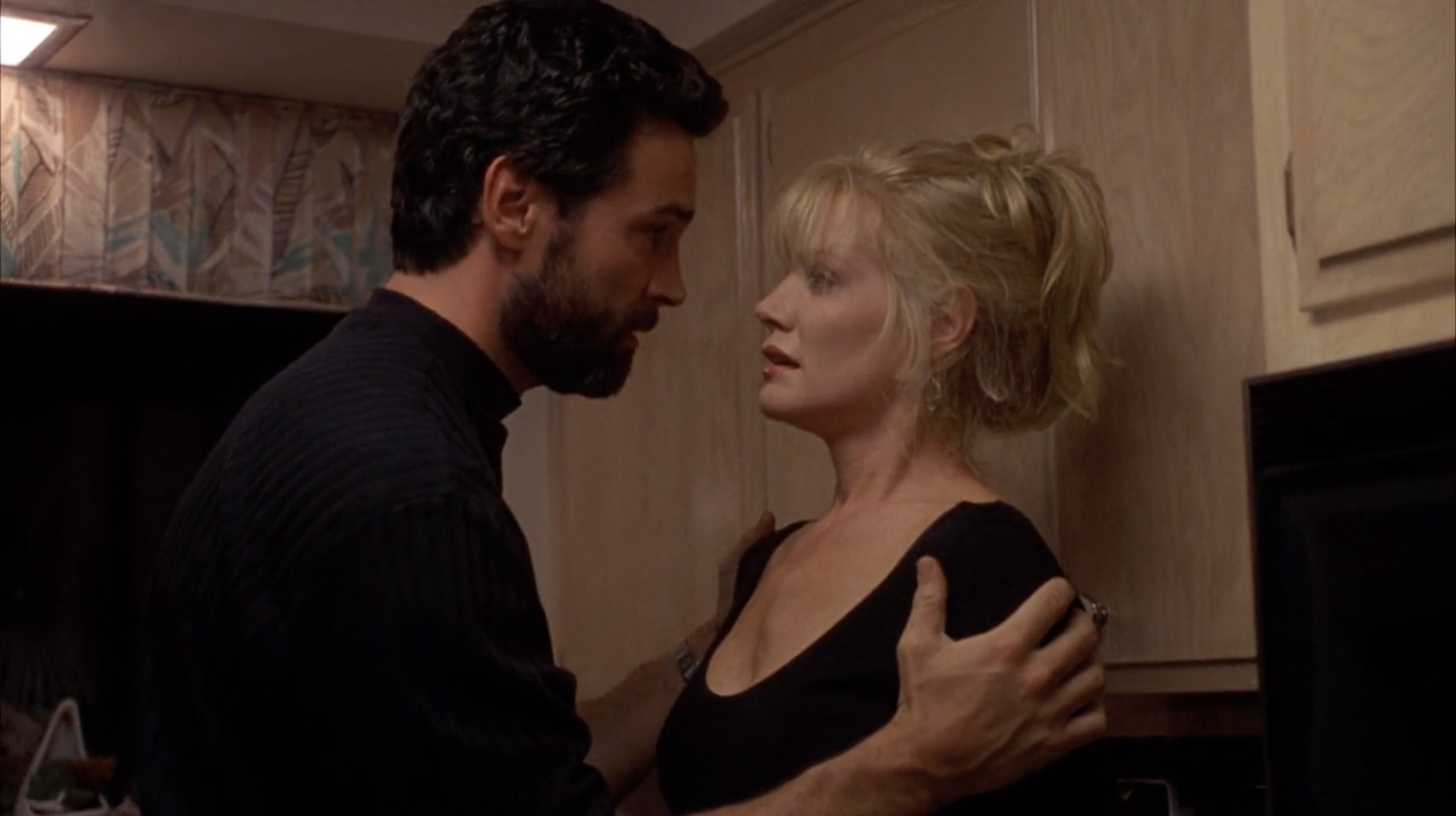
Shannon Tweed rose to fame in the early-80’s via Playboy, becoming the Playmate of the Year in 1982. She started her acting career shortly after, scoring an extended role in the daytime soap Days of Our Lives and tons of roles in one-off television episodes and B-movies. In the late 80’s and early 90’s, she started riding the wave of lesser known erotic thrillers, films that really took advantage of at least two of her…very robust talents. I was recently reading through some discussion about Vinegar Syndrome films and her catalogue came up as some recommendations for their library. I realized that, even with over a hundred acting credits to her name, I had never seen a Shannon Tweed film, so I picked Scorned, a film that was only ever released on VHS and laserdisc in the United States. Luckily, someone was kind enough to let me borrow an English-language German Mediabook version that was released on Blu-ray in 2018 with a run that only lasted 250 copies, so this baby is rare.

The plot is nearly a copy of 1992’s The Hand That Rocks the Cradle, but with way flimsier motivations for a woman who is clearly just deranged. Shannon Tweed plays Patricia Langley, a housewife to her husband Truman. Truman works for an architectural firm and he’s looking to secure a big partnership with some big businessman named Mason Wainright. They have Mason over for dinner, and he makes a move on Patricia. She’s horrified, of course, but in a shocking twist, her husband tells her that he has basically given Mason the greenlight to rape her in order to secure the job, and that she needs to take one for the team. What a company man. In a very uncomfortable scene, she reluctantly lets it happen, and the old creep grunts for about 45 seconds and leaves. The next day, Truman goes into the office with an extra pep in his step the next day only to find out that he didn’t get the partnership, that it’s been given to Alex Weston, one of his co-workers. Realizing he’s been cucked and bought a Camaro he couldn’t afford for nothing, he blows his brains out in his office.
Now, from the outside looking in, I feel like Patricia should be mad at the man who raped her and her spineless husband for letting - nay, inviting this happen to her, and while she does hold Mason responsible, she doesn’t blame her husband as much as she does the man who got the partnership, Alex Weston. She vows to go after him, his wife Marina, and his son, the only person on planet Earth named Robey. She arms herself with the best ammo in this kind of situation - information - and gets to work. Seems Marina has an addiction to pills and Robey is an idiot who’s not doing well in school, so she gets into the house under the guise of a tutor and starts trying to tear the family apart from the inside. She uses familiar tactics like trying to leave subtle hints that Alex is cheating on her, starts drugging her by putting pills in tea and coffee, seduces the high school senior son, and bangs his dad while he watches. The only person really suspicious at first is their Cuban housekeeper, Belle.

The plan seems sound enough, but soon after she infiltrates the Weston residence, we realize that Patricia is just batshit crazy. It doesn’t feel like she’s doing this for revenge as much as it feels like she’s just kind of roleplaying a fantasy of evil upon the family, most of whom didn’t have anything to do with Alex getting the job. For example, I can see why she’d seduce the son in order to turn him against his father, but when she goes back for a second helping, it’s hard to see why. He’s 17, surely he’s not great in the sack. She definitely enjoys it, at one point introducing the young buck to a copper cock ring. And she really lost all sympathy from me when she went after the only person on to her rouse, the innocent housekeeper. Then again, it didn’t seem like we were supposed to feel sympathy for Patricia at that point, we were just kind of along for the ride to see how far this evil woman would take things.

The film was directed by a guy named Andrew Stevens, a guy who wrote the early 90’s erotic thriller series Night Eyes 1,2, and 3, then disappeared for years until he popped up in 2007 to direct Half Past Dead 2, the sequel no one wanted to the Steven Seagal film no one wanted in the first place that replaced that ponytailed loser with WCW’s Goldberg and Death Row rapper Kurupt. He also directed a film called Fire Down Below - again, not the Steven Seagal film, but one with another braindead Hollywood asshole, Kevin Sorbo. There’s nothing that stands out about the direction here, but it’s easy to point out the haphazard editing, which frequently switches tones in such a jarring way that I’d have thought it was intentional in the hands of a crew with more skill. As it is, the film feels sloppy and rushed. The script, written by Barry Averich, is unoriginal and formulaic. More like Barry Below Averich. The real bright spot in the crew is Shannon Tweed, who I thought did a great job as the maniacal tutor. She had some real sly facial expressions that added a certain charm to her cruel debauchery as she attempted to pick people off one by one.
The End.

While not a strong film overall, I did have some fun watching it because it was so ridiculous and kind of surreal. Like I’ve said before, now, the erotic thriller genre is all but dead, so films like this that truly feel like softcore pornography at times just feel really out of place. My wife walked in while I was watching it and thought I was watching a porn…an easy mistake to make, as the one scene she walked in during was the one where Patricia was masturbating with her window open because she realized the son was spying on her. The fact that she actually sat through the next hour of it, however, is proof that there’s something compelling about it, whether you’re watching it for the sex - of which there is quite a bit, the bad acting, or just to see how things unravel in this fantastic web of flawed human beings. It’s tough to recommend this holistically, but I am interested in checking out more Shannon Tweed films, and it seems like Tubi has a few streaming.
Cloak & Dagger (1984).
The Stage.

A kid is on the run when he finds himself in possession of a video game cartridge filled with top secret information.
The Review.

When I was a kid, Cloak & Dagger was one of the video store holy grails when we’d go to the video rental store. The cover looked awesome, featured the kid from E.T., and I knew from the playground that it had to do with video games. If I had to guess, I finally got a chance to see it when I was eight or nine, and infatuated with Nintendo. I loved it as a kid, but hadn’t seen it since the salad days and couldn’t remember a thing about it. Recently, Vinegar Syndrome put out a fantastic package in 4K, which you can see pictures of on my Twitter or Instagram feeds, so I had to check it out.
Henry Thomas plays Davey, a kid with three friends; one friend is imaginary, a fictional spy named Jack Flack who he’s obsessed with (played by Dabney Coleman), and two are real - Kim, a girl his age who lives in his condo complex, and Morris, a nerd who runs the video game store at the mall. One day Morris gets tired of the kids hanging around and sends them on an errand and while there, Davey witnesses two hitmen kill a scientist in a scene obviously inspired by Hitchcock. The scientist stumbles out, hands Davey a video game cartridge titled Cloak & Dagger, and tells him to run before the hitmen finish him off by tossing him down a stairwell.

This kicks off a cat and mouse game in which our hero continuously outsmarts the three most inept criminals on planet Earth. Their first stop is to Davey’s home in a scene that’s got a sense of legitimate danger, but before the bad guys show up, we get evidence of a real emotional core to the film as Davey’s dad opens the door. It’s Dabney Coleman. Seems that Davey’s representation of the fictional character, Jack Flack is his dad, his hero. This little wrinkle pays off big time at the end of the film as well when Flack factors into the final showdown between Davey and one of the dumbass criminals. We also find out in this moment that Davey’s mom recently passed away - a perennial prerequisite in Reagan era kids films - giving us a crushingly sad moment that definitely made me wonder if all of this bizarre stuff that was happening was all in the kids mind, conjured by irreparable psychological damage considering how stupid everyone chasing him was.

Now, when I say these criminals are stupid, it’s got to be record breaking amounts of stupidity. There are several times when the bad guys find themselves within arms length of Davey and unload seven or eight bullets at him, missing every shot. This is especially weird later in the film, when one of the criminals kills a rat with a precise shot as it runs out of the shadows (shadows, by the way, that Davey is lying in and the bad guy doesn’t see him, despite the kid wearing a bright red jacket). One tries to stab him from just a foot away and misses, and then they even have the kid chloroformed and he ends up getting away. They’re literally the worst criminals money could buy, only able to kill adults, and even then, it’s when the victim doesn’t see them coming.

William Forsythe at his absolute nerdiest.
Speaking of that rat getting blasted, there’s a lot of crazy stuff going on here, par for the course in 80’s kids films. It’s obvious why I liked it when I was little. This film has a ton of silenced weapons, and they’re not just for show. Several people get shot or killed, including a character taking a bullet straight through the eye. There’s also a climax featuring a bomb on a hijacked plane, back in the days when you could just walk through airport security with one and no one cared. The ending is particularly explosive - I never knew how dark things would actually get, leading to some genuine suspense during the final showdown.
The End.

Despite being filmed from a script sporting plot holes like a slice of Swiss cheese, I liked Cloak and Dagger quite a bit. It’s complete nonsense, and definitely a film that, if made today, would be completely neutered…and with good reason. It’s dark as fuck. Children are not only put in danger (at one point, the main bad guy tells Davey he’s going to blow out his kneecaps which will hurt worse than any death, and then shoot him in the stomach so he’ll bleed out slowly) but they’re also dangerous, at one point killing someone with an actual gun. There are also some pretty scary scenes, including one twist featuring a person missing two fingers on their right hand. It definitely took me back to those days where you’d watch this at a sleepover and imagine yourself in the same situation.
The Vinegar Syndrome presentation is fantastic. Like I said, if you want a look at the packaging, take a look at the Instagram or Twitter feed. It’s got a beautiful magnetic clasp box and a slipcover made to look like an old, unofficial Atari game - spelling mistakes and all. The picture looked beautiful, and the extras plentiful. If you’re into those wacky, utterly irresponsible 80’s kids flicks, this one should bounce right to the top of your list.
Wild Things (1998).
“People aren’t always what they appear to be.”
Directed by John McNaughton
Written by Stephen Peters
Starring Matt Dillon, Neve Campbell, Denise Richards, and Kevin Bacon
The Stage.

A high school guidance counselor is accused of rape by two high school girls, but that’s only the tip of the iceberg in this lurid, twisty thriller.
The Review.

Wild Things came out at a time when I would see everything in theaters, and frankly, based on my tastes, it feels a little surprising that I hadn’t seen it up to this point. It came out when I was a junior in high school and I remember that it was talked about in class non-stop because of the threesome scene and of course because Denise Richards showed off the goods. I had always wondered if it would live up to its reputation that was so inflated in the Tracy High quad, but for some reason, never took the time to find out. Recently, Arrow put out a 4K restoration of both the theatrical and director’s cuts, so I picked it up during a buy two, get one free sale and away we went.
Matt Dillon plays Sam Lombardo, a high school counselor who’s accused of raping not one, but two students. He’s such a fantastic actor and I think his reputation for playing scumbags works to his advantage here, at least at first, before we find out what’s really going on. Denise Richards plays Kelly Van Ryan, the daughter of a rich widow. She uses her sex appeal to get what she wants, and she’s never looked better. I also thought she was really great as this spoiled teen who is in way over her head. Neve Campbell rounds out the…uh…threesome…as Suzie Toller, a stoner who continuously finds herself in legal trouble. I’ve never thought Neve Campbell was a good actor, and this film certainly reaffirms my views on that. She has always felt very one-note to me. Rounding out the cast is Kevin Bacon as a detective who’s gotten way too attached to a case after he felt bamboozed and Bill Murray as a sleazy, low-rent lawyer.

This film is a sweaty maze of shitty people. Literally everyone is into something they shouldn’t be, with one goal in mind…money…a goal that leads to quite a few murders. It’s a film that feels like it’s aware of how trashy it is, something that would have felt right at home as an episode of Melrose Place if the characters had taken a Brady Bunch in Hawaii style trip to the Everglades. The first half of the film lacked surprise for me, but the second half of the film came through with endless twists, deaths, and guess-what-I’m-not-really-deads. Stephen Peters, who wrote the script (and then literally nothing else) pulled out all the stops. As the credits roll, we find out the extent of the insanity that went on as sort of a recap, but even then, there are surprises being revealed.
The question I had to ask myself after the credits rolled is an obvious one - did it live up to the hype that’s sat in my head for over twenty years? In terms of the fabled threesome scene…unsurprisingly, no. Now, you have to understand, this came out at a time when scenes like this were very rare in mainstream movies and it was a time when porn was hard to come by. Either you found your parent’s stash or you found a magazine in the woods or whatever. Now, it’s a Google away, so by today’s standards, it feels very tame. However, Denise Richards is still titillating, even more so in 4K. I think I was most surprised by a two-second scene in which we see Kevin Bacon hang dong while getting out of the shower. Kevin’s Bacon indeed.
The End.

As the title card hits, we see a gator lift out of the water, letting us know that we’re in for some heinous stuff, and it didn’t let me down in that regard. It’s like an episode of Always Sunny in that every single character is a piece of trash and everyone is looking out for themselves, and they’ll do whatever they can to self-preserve. This film just SCREAMS late-90’s. It came out at the tail end of the golden age of erotic thrillers and feels like a pretty good exclamation point for this seemingly forgotten genre, with a soundtrack that brought me back to that junior year. The film is a good time-waster, and although I’m not sure I’ll take another dip in the pool that is Wild Things, I didn’t hate the hour and a half I spent with it.
The 4K restoration looks great, and the extras are nice too. There are new interviews with the director, John McNaughton, and Denise Richards, some archival interviews, as well as two commentary tracks and a lackluster outtake by Bill Murray. A nice booklet and a great looking box round out the package. If you’re a fan of the film, it’s never looked better.
The Old Ways (2020).
The Stage.

A young journalist is taken prisoner after exploring a cave that she was advised not to visit. The locals will not let her leave because they think a demon has made its way into her body.
The Review.

I’ve seen a lot of exorcism films in my time, and while The Old Ways doesn’t necessarily bring anything new to the tried and true formula, it’s certainly interesting, and that’s because of two things: it’s mythology and it’s very flawed main character.
Almost the entire film takes place in a small hut in the jungles of Veracruz. We’re put in the same situation as Cristina, the woman being held captive, as she tries to figure out what people around her are saying as the hood is taken off of her head. There are no subtitles. Most of what is conveyed about the…thing…they’re trying to excise from her is told through physical symbols and things written on the walls. There’s no explanation for the events, for the cures, we’re just along for the ride. The atmosphere is dank and dusty and the Spanish-language music is great.

Cristina is a character you’ll have a hard time rooting for…at least at first. We find out pretty quickly that she’s got a heroin problem, a very clear allegory for the mystical demon that is taking over her body. As she’s in a room with nothing to do but think, it’s easy to compare her waiting for the demon to be excised as a detox to get her clean. Of course this is a horror movie, so there’s more to it. There’s a moment late in the film where she brushes off all of the lessons she should have learned, but late in the third act, we see some tremendous growth. By the end, I was really behind Cristina, a testament to a good script as well as the acting by Brigitte Kali Canales who most people would probably know as Rachel from Fear the Walking Dead. She nails the care-free American who barges in on the locals and thinks she can get away with it because “I’m an American” who transforms into someone who respects local mythology.
There are only three other characters in the cast. Miranda, Cristina’s estranged cousin, Luz, the old woman who’s trying to excise the demon, and her son Javi, who is trying to keep everything together at the hut. They’re all fine in their roles, particularly Julia Vera as Luz, an Indigenous shaman with roots going back to pre-Aztec times, trying all the tricks in her playbook to vanquish the demon.
There isn’t much in the way of gore, but there are some really stomach churning scenes involving things coming out of Cristina’s body. We do get a few glimpses of the creature and I thought they were pretty well done.
The End.

The way things play out is nothing you haven’t seen before if you’re a fan of exorcism films, and it isn’t really scary, so if you’re looking for the next Exorcist, this isn’t it…but I enjoyed The Old Ways nonetheless. It’s well written, even sprinkling in some comedy here and there with lines that probably would have played great with an anxious crowd. The film lost a bit of steam in the middle, but never enough to lose my interest before it ramped back up in the third act towards a fun close. I dug it and recommend it.
Top Gun: Maverick (2022).
“Don’t think, just do.”
The Stage.
36 years after graduating from the Top Gun program, Pete Mitchell, call sign Maverick, is a Navy captain testing experimental aircrafts. He’s called back to the Top Gun program to train a pack of twelve elite pilots - including Goose’s son - for what looks to be a suicide mission.
The Review.
I think that the original Top Gun is a fantastic movie. I saw it when I was young and just loved everything about it - the drama on the ground, the drama in the air, the plane work. I think it’s one of the first movies I’ve ever cried during when a certain character dies because I just didn’t see it coming back then. The script by Jim Cash and Jack Epps really made you care about every character, which made the wins and losses matter. The missiles and dog fighting were simply icing on the cake.
I disagree with those who think that a bad sequel has a negative impact on the original film, but when you really love a film and it has a terrible sequel, it’s an immense feeling of disappointment. That was my big concern when, years ago, I heard that they were making a Top Gun sequel. But those fears quickly came to a rest because I knew that Tom Cruise wouldn’t let us down. Tom Cruise happens to be an actor who just loves movies, and he loves the audience experience while watching a movie.
In short, if you liked the original Top Gun, and I think most people do, you’re probably going to love this film. This script, by Peter Craig and regular Cruise collaborator Christopher McQuarrie, gets the same things right that the original did - it makes us fall in love with an even bigger cast of characters and the rest comes second, so that when there’s smoke in the air, you care. The wrench here is the addition of Miles Teller as Rooster, Goose’s son. He and Maverick have beef because Maverick pulled his papers to join the Navy, knocking precious years off of Rooster’s Navy career.
The other pilots are great too. The new class standouts were Hangman, the modern day Iceman, Phoenix, a level headed Top Gun grad, and Bob, a soft spoken wingman. Jon Hamm steps into the hard ass Vice Admiral role as Cyclone, another old timer from the Top Gun program. And it wouldn’t be a Top Gun film without a love interest, played by the ever charming and absolutely gorgeous Jennifer Connelly. It also wouldn’t be a Top Gun film without a shirtless sport on the beach scene, and we get a nice “dogfight football” game that’s a very fun (but not as horny as the original’s beach volleyball game) moment. That being said, the call backs are pretty light compared to many legacy sequels. There are only two characters that return, focusing on the future and not the past, something that I really respected.
Most of the film is centered on training for a mission to blow up a uranium plant. The catch? It’s basically a suicide mission. It’s in a crater that’s surrounded by huge inclines, and can only be reached by a ridiculously tough to navigate valley. Tom Cruise’s requirement for coming back to Top Gun was that the planes could not be CG, and what a fucking difference it made in any scene where someone was in the sky.
Much of the film takes place in the cockpits of F-18s and you see - scratch that - you feel the actors soaring through the air. Every single time there’s a plane scene, it just felt thrilling, including the training sequences. When we finally get to the mission, the stakes feel real. The movie is very predictable, but somehow I still felt myself gripping the arm of the theater chair hoping that each pilot would make it out alive. The finale to this film is, simply put, a white knuckle ride with several moments that are absolutely breathtaking. This is a film that will hold up in thirty years in the same thrilling way because it doesn’t just feel real…the majority of what you’re seeing is real.
In the beginning of the movie, Admiral Cole tells Tom Cruise that pilots aren’t going to be needed much longer; drone technology is getting so advanced that eventually, they’ll be replaced. To this, Maverick responds, “Maybe so sir…but not today.” One might take that as Maverick just sticking one to the Rear Admiral, who was originally on his way to sack him, but I took that as Tom Cruise telling the audience that CGI and deep fakes might be the future of film, but…not this one. I’ve said it before - Tom Cruise feels like the last true movie star, and films like Top Gun: Maverick simply reaffirm that. You see him in the cockpit doing fucking spirals. You see him taking so much g-force he’s basically passing out in front of your eyes.
There are a lot of Tom Cruise detractors, most of that coming from him being a scientologist. I could not care less what he does in his spare time, because honestly if you look logically at any religion, none of them make sense. From the floating cloud man who was nailed to a cross and came back as a zombie to whatever the fuck scientology is, they’re all batshit crazy. All I see on screen is a man who cares so much about the industry he’s in, that he’s probably willing to kill himself for it.
The End.
Before the movie started, there was a thirty-second message from Tom Cruise. He thanked us for coming to the theater to see his movie, because he made it for us. Thank you, Tom Cruise. Both my wife and I had a fantastic time at the movies, and you were the reason why. It made us laugh, it made us cry, it made us fist pump. With traditional blockbuster films on the brink of extinction, sitting next to a CGI dinosaur film and a CGI super hero film on the theater marquee, Top Gun: Maverick kicked practical ass.